Showing posts sorted by relevance for query taos pueblo. Sort by date Show all posts

Sunday, June 17, 2012

Visit to Taos Pueblo

Last weekend we had an incredible opportunity.  We were invited by Bonnie Burnham, President of the World Monuments fund (WMF) and Frank Sanchis, Director of Programs in the United States to join them in Taos, New Mexico, a 90 minute drive from Santa Fe, for a visit to the Taos Pueblo.  I have known Bonnie since the mid 1970’s when we attended the first international conference on art theft when she was working with UNESCO. 

The night before our visit there was a dinner with The Friends of Heritage Preservation (FOHP) founded in 1998 by Suzanne Deal Booth.  This group predominantly from  Texas and California were contributors to the WMF project at the Taos Pueblo.  After cocktails Frank Sanchis did a slide presentation of the  project which involves an 11 room building at the entry to the Pueblo known as Sub-House #2.   There had been a fire and the building was in danger of collapse. It was explained to us that it was close to a million dollar project of which 10% was for a company that could take measurements of the structure from all its angles using laser or lidar (light detection and ranging) technology.  This included a drone that would fly over the Pueblo taking measurements. 

The next morning we all met at the entrance to the Pueblo, about 20 of us, and were escorted into the village where a receiving line from the Tribal Council greeted us, including the governor and lieutenant governor of the village.  We all shook hands and were then led into a meeting room which was set up with architectural sketches of the project as well as a model.

Before we were sat down the Secretary of the War Chief’s office grabbed me for a brief personal chat.  He told me he was lucky enough to live in the “North” building, which I learned was the main Pueblo, the famous image of the multi storied house that has come to symbolize the Taos Pueblo.  His rooms were on the back where he could see the forests and mountains of his ancestors.  When you think about it, who would want to be on the front where you would have to watch and listen to the tourists all day long!

The Main Pueblo

In the meeting room there were homemade cookies and cakes put out for us as well as a bottle of water at each place when we sat down.  The governor said a traditional blessing in their native Tiwa language.  Then he and the lieutenant governor explained the set up of the tribe as well as describing the project in detail. He told us that the people are considered as on the top rung of the ladder with the governor and tribal council below that.  The tribal council does not change and a governor and lieutenant governor are elected from the council by the tribe for one-year terms. We then learned about some of their issues regarding the return of their native lands confiscated by the U.S. Government.  it was amazing to hear about their successes and how politically astute they were.

Afterwards, we were introduced to the foreman who spoke a little bit about the project and then he introduced his crew each by name.  This was particularly relevant as World Monuments Fund does not just put money towards a project but their goal is to teach the people how to do the restoration work themselves so that they will be able to continue on their own.

Introduction of the Workmen

Our pockets were filled with the remaining cookies and we were sent off with guides to see the preservation site in detail as well as much more of the Pueblo.

Work at Preservation Site

The work on Sub-House #2 is being done in the traditional manner with hand-made adobe bricks.  The tribe’s goal is to reproduce exactly what was there before.  Other tribes doing restoration work on their pueblo sometimes wish to have some modern conveniences such as running water and electricity but not here.  If the Taos people want these conveniences they must live beyond the walls of the village.

There were many impressive sites to see but what I found the most profound was the cemetery.  Though they still bury people there it is not large enough to accommodate all so they have started a new cemetery beyond the walls of the Pueblo.

In the center of the old cemetery are the ruins of the first church on the Pueblo called St. Jerome’s, the patron saint of the pueblo.  It was built in 1619 and destroyed at the time of the Pueblo Revolt of 1680 but then rebuilt in 1706 after the Spanish returned and destroyed yet again in 1847 during the Mexican war.  Today a new Church of St. Jerome stands as a show piece in the middle of the plaza.

Ruins of St. Jerome


Church of St. Jerome

We learned much about life on the Pueblo and dependence on a stream that brought water down from Blue Lake above the village.   We learned about their politics and religions (Christian and Native).  What more can you ask than to get an insight into what amounts to a foreign society and learn of their goals and aspirations.

Sunday, December 11, 2016

Who is Mabel Evans Dodge Sterne Luhan (1879-1962)?

The answer can be found in the exhibition “Mabel Dodge Luhan & Company: American Moderns and the West” currently at the Albuquerque Museum.  In a nutshell she was the “hostess with the mostest".

The show was organized by the Harwood Museum in Taos where it opened traveling to the Albuquerque Museum.  The guest curators for the show are Lois P. Rudnick and MaLin Wilson-Powell. Lois is a professor emerita of American Studies from the University of Massachusetts in Boston and has written voluminously on Mabel Dodge.  MaLin is an art historian, independent curator and author who has concentrated on the art of the Southwest.   Their show has been 36 years in the making since MaLin applied for an NEH planning grant in 1980.  It never came to anything, however, since museums had no particular interest in Mabel Dodge.  According to Rudnick until relatively recently no museum would have considered doing a show about someone who “was not an artist but a cultural catalyst”.  The world changes and when it is ready it will come.

I am sure that one of the exhibitions that opened up this possibility was a show at the Metropolitan Museum in 2012 called “The Steins Collect” about the incredible collection that Gertrude Stein and her family put together.  Of course, Gertrude Stein is far better known on an international basis but as far as opening the southwestern United States to the art world Mabel Dodge was a major figure.  She had a relatively simple methodology.  She just asked everyone who was anyone to come stay with her.  To quote Mabel Dodge, herself in 1913, “I wanted to know everybody and … everybody wanted to know me”.  They were not just painters and sculptors but included writers such as D.H. Lawrence.

Here is Mabel’s story. She was born to a wealthy family in Buffalo New York  (the final venue for the show will be at the Burchfield Penney Art Center in Buffalo starting at the end of June, 2017).  In 1902 she marries her first husband, Karl Evans, who dies in a hunting accident the following year leaving her with a son.  In 1904 she moves to Paris, meets and marries Edwin Dodge and the couple establish a salon in their villa near Florence.

Meeting Leo and Gertrude Stein and seeing their fabulous collection of paintings including Cézanne, Matisse, van Gogh and Picasso transforms Mabel’s taste and changes her view of art.  She had felt suffocated by the art of the past.  (As an art dealer I can tell you that children rarely like the art that their parents collected.)

In 1912 she moves with her husband and son to New York City where she established a salon in her Greenwich Village apartment and participated in organizing the famous 1913 Armory Show.

She divorces Dodge and marries the artist Maurice Sterne.  He establishes a painting studio in Santa Fe and entices Mabel Dodge to come out and soon after they move to a town north of Santa Fe, Taos. Here she becomes involved with Tony Lujan, an Indian from Taos Pueblo, who advises her on building a home (now a bed and breakfast). She divorces Sterne to marry Lujan in 1923.


The current exhibition revolves around the artists and writers who Mabel brought out to Taos In another way, however, the show is a view of the history of art in New Mexico in the 20th century.  Thanks to her final marriage she became a great defender of the Indians and brought all her artist friends to the dances at Taos Pueblo.  She wrote about and expanded the market for the Native American artists.  Here is a watercolor by the artist Velino Shije Herrera (1902-1973) from Zia Pueblo.  It was lent by the School for Advanced Research in Santa Fe.


A key work in the exhibition representing Mabel’s patronage and role in introducing Modernists to the West is “Abstract Arrangement of Indian Symbols” (1914-15), oil on canvas by Marsden Hartley (1877-1943)  which she bought and today is in the exhibition Courtesy of Yale American Literature Collection, Beinecke Rare Book & Manuscript Library.  Mabel left her archive of photos, letters and manuscripts said to weigh 1500 pounds to the Beinecke.


In 1927 Mabel Dodge had her portrait painted by, Nicolai Fechin (1881-1955), a Russian émigré who had arrived in Taos the year before.  He portrays her as the Grand Dame she believes she is.  Today the Nicolai Fechin House is a tourist attraction in Taos. The portrait, however, was lent by The Museum of Western Art, Denver.


One of the paintings I find the most effective in the show in its empathy for the Hispanic culture of Northern New Mexico is “Mexican Wake” 1932 by the Hungarian-born Modernist  Emil Bisttram (1895-1976.  It was a gift of the artist to the University of New Mexico Art Museum in Albuquerque.


Another amazing painting possibly the best one the artist ever did is one called, “Hunger”  1919, by Walter Ufer (1876-1936) lent by the Gilcrease Museum in Tulsa Oklahoma. Ufer, an Anglo artist became something of a hero on the Taos Pueblo as he worked night and day side by side with the doctor ministering to victims of a devastating flu epidemic 1918-1919.


You will have to forgive me but now that I am a Santa Fean I cannot end without mentioning Georgia O’Keeffe (1887-1986).  She herself said to Alfred Stieglitz in 1929, “…the whole world comes to Mabel’s” as she did herself.   Of her painting  “Gray Cross with Blue”, 1929, she wrote “… the cross stood out-dark against the evening sky … I saw the Taos mountain-a beautiful shape.  I painted the cross against the mountain …”  It comes from the Albuquerque Museum’s own collection.


The show is so rich with material I do not have room to include the Spanish Colonial material, the decorative arts or the wonderful photographs that include Weston, Adams and Stieglitz.  So I hope you will be able to go before the show closes on January 22, 2017.

*Images of the Fechin, Hartley,  Ufer and O’Keeffe are courtesy of the Albuquerque Museum.

Sunday, October 23, 2022

The High Road to Taos

I have not written about Taos, New Mexico, for some time but this take is a little different from the others. A couple of days away from town was a birthday present from my wife, Penelope. The idea was not only to get away for a night but to do it in the fall which, like in many places, is so beautiful at this time of year. 

There are two ways to get to Taos from Santa Fe. One is relatively direct and takes roughly an hour and a half. The other, the high road, takes about an hour longer. Of course, it depends on your speed but with all the hills and switchbacks it also depends on your driving skills and, I’m afraid, your age! But boy is the high road worth it.

It is hard to take photos from a moving vehicle on a curving mountain road but there were a few, very few, places where a car could safely go off the road as photo opportunities. From this one view I took you can see why in 1975 the High Road was listed in the New Mexico Register of Cultural Properties.


In 2016 Mike Butler published a book called “The High Road to Taos” with about 200 black and white photos dating from the 1930’and 40’s from The Library of Congress. The High Road has always been a tourist and pioneer attraction.

Some guidebooks give you up to seven hours to take the High Road because there are so many historic villages and pueblos along the way. In 2012 I wrote about our tour of Taos Pueblo ...
https://www.geraldstiebel.com/search?q=taos+pueblo

Penelope had picked our luncheon spot called Sugar Nymphs Café in the village of Peñasco.


To give you an idea of the vintage of the place, these old fashioned washing machines stood outside.


The café shares the building with an old time theater which I could only peak into. In the “lobby” was a vintage movie projector.


It did not look like a great place to eat but i was in for a very pleasant surprise.

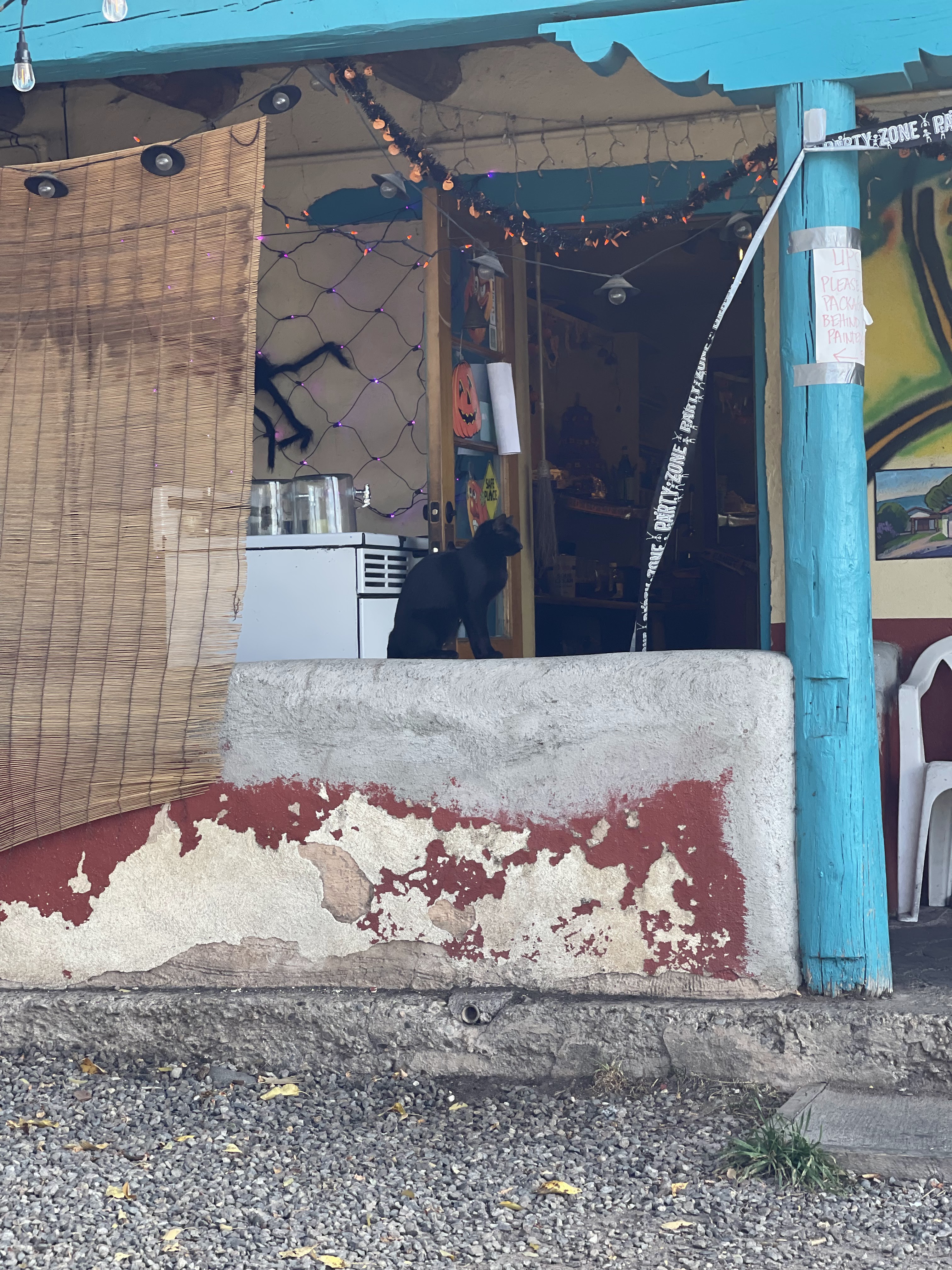
I ordered my favorite chili cheeseburger and Penelope a BLT, simple but delicious, mine was no patty but a thick burger cooked to rare perfection. It came with a large bowl of cauliflower soup. Did not sound that great to me but home made with lots of vegetables. If I return some day, I hope they have that soup again. We had to sample their signature drink made with syrups and berries like I have never tasted before. Adding to the atmosphere was a totally black cat with bright green eyes.


Coming into Taos we passed Saint Francis Church, Rancho de Taos, a famous subject for Ansel Adams and Georgia O’Keeffe. When we were there six years ago, we were pretty much alone but the church was closed. This time the parking lot was full and we did get into the church, as guests for a wedding were just dispersing, everyone decked out in their Sunday best. Here is Ansel Adams’ 1929 photo of the church.


We stayed at the Historic Taos Inn, which opened in 1936 and has retained its style. Its restaurant, Doc Martin’s, lived up to its reputation with a great chili relleno and margaritas. Our room was small but really cozy, with fireplace in a reading nook.


The next morning, we visited the Taos Art Museum at the Fechin house, home of Nicholai Fechin (1888-1955) a Russian painter who specialized in portraits. Here is a 1933 portrait of his daughter, Eya.


Born in Kazan, Russia he came to the United Sates with his wife and daughter in 1923. The family lived in Taos from 1927 until 1933. During that time, he transformed and added to an adobe house which is today listed on the National Register of Historic Places. He not only carved the furniture but incorporated architectural ornament recalling Russian folk art.


Returning home via the low road, the pouring rain made us very happy that we had come in on the high road on a beautiful sunny and warm day.

Sunday, September 21, 2014

The Alcove Shows 1917-1927

Two years ago I wrote a Missive called the Alcove Shows where you can see their genesis. That exhibition returned to the New Mexico Museum of Art’s initial use of alcoves to present the work of contemporary local artists.

When the Art Gallery (now the New Mexico Museum of Art) of the  Museum of New Mexico was established by Edgar Lee Hewitt in 1917 he had an open door policy where any artist working in New Mexico could put up a show of his work in one of the alcoves for a month on a first come first served basis.  “The Alcove Shows 1917-1927” is a historical exhibition showing the artists who were around at the time and exhibited in one of the alcoves.

I have one quibble with the exhibition, which I will dispense with at the beginning.  I always go around an exhibition or a fair counter clockwise particularly in a small show.  Unfortunately, for me, this exhibition, although laid out in a roughly chronological order,  was conceived in a clockwise manner with no explanatory label of the show on the outside walls.  Therefore, I only saw it on my way out! Only then did I discover the first alcove devoted to samples of the different  types of art exhibited in the Art Museum in its early years, not just paintings but other ethnographic materials such as Japanese woodblock prints and pre-Colombian art.

Every artist in the original alcove presentations came from elsewhere.  Many had studied in Paris but with the advent of World War I artists were staying at home.  Traveling almost as far, they came to exotic Santa Fe and the wonderful landscapes and ethnic varieties that it offered.  In the first alcove a set of pueblo pots shown near a 1917 painting by Henry C. Balink  (1882-1963) called “Pueblo Pottery”  demonstrates the cross-cultural fertilization that occurred in this part of the world.

Photograph supplied by the New Mexico Museum of Art


Just as you cannot believe Georgia O’Keeffe’s clouds until you have actually seen them in the New Mexico skies, you cannot understand the cloud patterns or the amazing light in the morning and evening skies.  A painting done in 1917 called “Light” by Raymond Jonson (1891-1982) gives a vivid representation.  It is quite different from much of his flat abstract work.

Photograph supplied by the New Mexico Museum of Art

I have quite a number of favorites in the exhibition “The Basket Ceremony” ca. 1922. by Alfonso Roybal (Awa Tsireh) (1895-1955). Roybal was from San Ildefonso Pueblo and this is typical of the kind of painting that Dorothy Dunn would soon be teaching at her Studio School in Santa Fe.  Many of the most famous Native American artists studied with her.


An artist that I mentioned last week is Ernest L. Blumenschein (1874–1960), he was a member of the Taos Society of Artists.   At the beginning of the 20th century it was a major trip between Taos and Santa Fe but like today, exhibition space was paramount  for an artist if he wanted his work known so he came to exhibit in the Alcoves.  This is his “Dance at Taos” from 1923.

Photograph supplied by the New Mexico Museum of Art

Another favorite is “Ancestral Spritis (The Koshare)” of 1919 by John Sloan (1871-1951).  Here is another case where an artist known for a totally different kind of painting has adopted not only Indian subject matter but also an interpretation that seems directly taken from the Indian dances.  We are at the center of Native American, Hispanic and Anglo culture in New Mexico it is fascinating to see the influences that each had on the other.  In contrast look at Sloan’s “Music in the Plaza” of 1920.

Photograph supplied by the New Mexico Museum of Art

Photograph supplied by the New Mexico Museum of Art


One of the facts that surprised me is that between 25 and 50% of the artists who participated in the Alcove shows were women. 

I “discovered” the photographer Laura Gilpin (1891-1979) back east at New York museum exhibitions and galleries like the Witkin Gallery.  I am not sure I even knew where Santa Fe was at the time.  She was born in Colorado, educated at Eastern boarding schools, studied photography in New York, went back to the west, ended up in the Santa Fe art scene. The other evening I sat next to a woman at dinner who told me that Laura Gilpin had taken her baby pictures and photos of both her and her husband when they were children.  Clearly Ms. Gilpin, a small thick set woman with her ever present camera  and tripod had to make a living on more than the art photos that are so highly prized today.   Here is an image she took in San Ildefonso in 1927.


There are 61 works on view representing 24 artists so there is plenty more to see and discuss if you want to learn more about the art of the Southwest.   The exhibition was masterfully guest curated by Malin Wilson-Powell and the will remain on view until February 23, 2015.

Sunday, July 16, 2017

Looking Fondly on the Past

An exhibition called “Voices of Counterculture in the Southwest”  is at the History Museum of New Mexico.  It covers the “Summer of Love” 1967 through the 70’s in the southwest by which time the counterculture had already been active on the coasts for some time.  The final moments of the latter were probably with the ousting of Nixon and the end of the Vietnam war 1974-1975.

Meredith Davidson is curator of the 19th and 20th century southwest collection.   She did the exhibition together with Jack Loeffler, the renowned, historian, author, musician, activist and a member of the southwest counterculture movement.  They cooperated both on curating of the show and gathering the articles for the book accompanying the exhibition.   Loeffler wrote a number of the essays and in the final one called “Ebb Tide” he write, “Through the ages, countercultures have been marked by a refusal of governance from on high, a hatred of bureaucracy, a profound strain of anarchism, a thread of pragmatism.”   In an article in El Palacio, the magazine for the State Museums of New Mexico, Ms. Davidson adds, “… back to the land lifestyle …” was also important.

Jack Loeffler at the Gallup Indian Ceremonial, 1971
(SOURCE: Museum Of New Mexico Press)


From the press release: “Curators, Meredith Davidson and Jack Loeffler, tell the story of cultural revolution through first person audio from over 50 interviews with those who lived through the era. Documentary photography and artifacts help reinforce the role that individual actions take in shaping the course of history. So many of the social and political issues of the day still resonate and the museum will invite visitors to share their own stories in an audio feedback booth.”

Ms. Davidson’s expertise is in oral history,  so naturally there is a great deal of material well communicated by voice. Alan Ginsberg’s reading of his poem, “Howl” which he wrote already in the mid-fifties,  comes at the beginning of the show. It is fascinating since it prefigures the entire counterculture movement. Unfortunately, there is a lot of sound bleed so it is difficult for my old ears to be able to distinguish where the sound is coming from or understand what I am listening to.

There is an admirable effort in this exhibition to show how southwest counterculture  differed from that of the east coast.  Haight-Ashbury in San Franciso which became famous as a hippie capital and cradle of the Gay Rights Movement had its equivalent in the southwest where  Taos, New Mexico was the refuge of the hippies.

A section of the show deals with the best known of the communes, The Hog Farm, started in California. In the mid 60’s they moved to New York and by 1969 they bought land in Llano, New Mexico near Taos, still they agreed to stay and be involved with the Woodstock Music Festival  building fire pits, trails and a free kitchen.  Here is a video by Roberta Price a well known photographer giving a good idea of the concept of the exhibition.  It is called across the great divide and made in 1969.  Music from the story “Woodstock” by Joni Mitchell.

One of the catalog essays is by Rina Swentzell, a native of Santa Clara pueblo who became a very close friend when we started to settled in Santa Fe. She wrote about early life and marriage to Ralph Swentzell, an Anglo, and of their time in Taos when they were absorbed in the counterculture life. Even when her husband became a teacher at St. John’s College and they built their own lovely home in Santa Fe, they would rent it out to those coming for the opera season and spend weeks at a time in a VW bus traveling around the country.  That did not change after their three daughters were born.


Peyote, Marijuana, Timothy Leary and LSD were all associated with the counterculture movement of the 60’s and 70’s. Even though Peyote was smoked by the Indians since time immemorial, in 1937 a law was passed against smoking any leaf that could produce a high.


Free love, drugs, back to the land, I regret never having participated in any of these and I have always ascribed it to cowardice!  On the other hand, they have always been fantasies of mine and this exhibition reawakened those fantasies.  I saw others at the show clearly reminiscing about the years of their youth .

Sunday, November 27, 2016

Kit Carson (1809-1868)

On a recent visit to Taos, New Mexico, known to most as a ski resort and the model of what people think of as an Indian Pueblo, it was also the home of many famous artists and Kit Carson, who played an important role in the Westward expansion of the United States. The hero of my youth has been reviled in recent years as a symbol of the Anglo mistreatment and removal of Native Americans from their lands. The park in Taos where he is buried bears his name despite a recent attempt to rename it, and his home is now a modest museum.


Carson’s life was a classic story of  the American  frontier. When he was one year old his parents moved from Kentucky to the new frontier, Boone’s Lick, Missouri.  He was the ninth of fourteen  children and both his parents died before he was 10 years old.  There was no time to get a formal education.  By the age of 14 he was recorded as being apprentice to a harness and saddle maker.  Within a year becoming restless he hooked up with a wagon train heading down the Old Santa Fe Trail to Santa Fe.  He later went up to Taos, which was his residence for the rest of his life, though he spent precious little time there.  Over the years he was a fur trapper (known at the time as a mountain man), a wilderness guide, an Indian Agent and American Army officer.

When Carson was 19 he was hired to go on a fur trapping expedition to California.  Later, he was appointed as the hunter for the garrison at Bent’s Fort, Colorado.  There was obviously no food delivery to the frontier and the troops had to be fed. 

His travels had him interacting with the Indians and learning several of their languages.  During his lifetime he had three wives, one was Arapaho, another Cheyenne and the third was Hispanic.  The first died shortly after a daughter was born to them who he loved dearly,  taking the best care of her he could.  In 1842 he took her back to Missouri where she could be educated in a convent.  During his return he happened to meet John C. Fremont, the military man and explorer, on a Missouri River Boat.  They got along immediately and Freemont hired Carson as a guide for his first expedition to map and describe the trails to the Pacific Coast.  Freemont’s accounts of the expedition brought Carson to National attention.


Kit Carson had a long and troubled relationship with his legend.  He was most surprised when he first saw a book about himself describing him as a hater of Indians who killed them whenever he could.  The first “dime store novel” came out already in 1840 and he detested them all but there was nothing he could do.  More recently he has been described as a racist, a ridiculous idea considering his marriages alone.

Did Carson fight with the Indians?  No doubt, but he was also recognized by many of them as someone who was totally straight and did not go back on his word.  “Nothing is ever as good as it seems or as bad as it seems.”  This is true for people too.

Carson was in charge of the forced deportation of the Navajo people from their lands known in the oral history of the Navajo as “The Long Walk”. The notion of rounding up and relocating the Navajos, who along with the Apaches, were considered a threat to settlers, was the misguided vision of General James Henry Carleton, head of the Union Army in the territories of New Mexico and Arizona. The Navajo were meant to be converted from nomadic sheepherders to farmers but the chosen resettlement land along the Pecos River was completely incompatible to agriculture.  Carson had objected to the plan but Carleton insisted he carry out the round up and forced march as his patriotic duty.  Many Navajo died for a number of reasons including attacks by enemy tribes, being moved during the winter and nothing would grow on their new land but later many agreed that far more would have died if Carson had not been the one leading the march.

My father always said “I believe everything I read unless I know something about the subject.” So it is with Kit Carson. For the best biography of his life and a full view of the frontier in his time get Hampton Sides’ book, “Blood and Thunder: The Epic Story of Kit Carson and the Conquest of the American West.”

Sunday, October 25, 2020

Art that Makes Me Smile

These days we need to try to laugh and smile through the tears.  Being restricted to home more than usual I draw on our personal art collection.

When my wife wanted to rush me to close my art business in New York and join her here in Santa Fe full-time, (turned out to be the best decision of our lives) she lured me by allowing me to buy a wide screen TV and amplifier speakers, DVR, DVD player etc. Shortly thereafter we saw a cartoon I could not resist as it spoke to my personal moment.  It is by Ricardo Caté, of Santo Domingo Pueblo, whose cartoons titled “Without Reservations” have appeared in the local Santa Fe newspaper, The New Mexican, every day since 2006.  He describes Indian humor as the result of “us living in a dominant culture, and the funny part is that we so often fall short of fitting in.”   We bought the watercolor from Ricardo at his first Indian Market, an annual event in Santa Fe and it filled his characterization perfectly. That modest acquisition cost us only $20 but it was the first of many more ambitious examples of Caté’s work  that we now own.


Most of my life my work has been with artists who have long since past, but I have learned that works by living artists can afford a more immediate experience. One example is the carved wood sculpture that hangs in our home.  We acquired it when we were driving up to Taos, New Mexico, not for the skiing for which the town is famed, but for my wife’s shoulder surgery with the orthopedic surgeon to the Olympic ski team.


Since we can hardly ever pass up an art shopping opportunity, we stopped on the way at the Chimayo Trading del Norte at Rancho de Taos.  There we discovered this unusual mask that reminded us of Commedia dell'arte but was signed by a well-known Warm Springs Chiricahua Apache sculptor, Bob Hazous. Since we had met the artist previously, I wrote to him. asking about our purchase.  Here is his reply: “I have always enjoyed the Italian theatrical masks since my first visit to Venice … My mask: I don’t recall the exact time when it was created, probably somewhere in the late 1980’s … I clearly remember making the mask, probably looked at as a humorous piece by some, but to me it represented an aesthetic and compositional challenge, probably inspired by the eyeglass frame [most likely the antique trade sign for an optometrist]. Where that came from, I couldn’t tell you. I surround myself with junk of all kinds for inspiration to be used in an artwork or contemplation. Your photos are great. Thanks for sharing that almost lost memory.”


My final smile for today is a Hopi carved wood sculpture of an embracing couple. The figures are a yellow clown and a Kokopelmana, who is the female fertility Katsina in the Hopi religious pantheon of spirits.  The group is signed RG on the base for the Hopi carver, Ros George. He specializes in making small sculptures out of a single piece of cottonwood using only a pocketknife and an Exacto razor knife.  


We acquired the piece five years ago at an auction to benefit Santa Fe’s Wheelwright Museum of the American Indian.  Adding to the provenance was the fact that it had been donated to the auction by a prominent dealer, Lynn Fox who specialty is Native American pottery.  He told the Wheelwright that it dated from 1995, which was the height of realistic action Katsina figures.


So, here are three smiles in our home: one acquired directly from the artist; another from a trading post (for those not acquainted with the Southwest, read art dealer); and lastly at a charity auction.  If you are a collector, you seize opportunity wherever it presents itself.

Sunday, June 15, 2014

Southwestern Allure


 “Southwestern Allure:  The Art of the Santa Fe Art Colony”, currently at the New Mexico Museum of Art, would be an obvious exhibition to have  originated somewhere in the Southwest, but it did not.  Instead it comes out of the Southeast, --Boca Raton, Florida.  The Director of the Boca Museum of Art, Steven Maklansky explains in the introduction to the catalog for the show, “Here in Boca Raton we understand how a warm climate, attractive natural resources and a bit of optimistic city planning can make all the difference.”  I guess it is a choice do you prefer the mountains or the sea?

The show is guest curated by an art historian and independent curator, Valerie Ann Leeds, out of New York.  Her field of expertise is American art and she-has written several books on the artist Robert Henri (1865-1929), who, it turns out, had a strong Santa Fe connection.

New Mexico only became a State in the 20th century, 1912 to be exact.  Edgar Lee Hewett (1865-1946) who was an anthropologist and archeologist by training turned into the guru of all things art at that time.  He felt that the historic Palace of the Governors in Santa Fe, where he established the Museum of New Mexico in 1909 was not enough to exhibit the work of all the artists who were coming to Santa Fe, so he campaigned for the construction of a separate art gallery, now the New Mexico Museum of Art, that opened in 1917.  It’s architecture was the model for what is now known as “the  Santa Fe Style”.

Robert Henri was a great influence on Hewett who convinced him to come to Santa Fe where a group of artists was already in residence in 1916.  Henri had trained in the academic tradition at the Pennsylvania Academy of Fine Arts and in Paris. but became one of the leaders of the Ashcan School, and the organizer of "The Eight", a group of artists who objected to the restrictive exhibition practices of the conservative National Academy of Design in New York.  In Santa Fe, Henri could do something about it, He convinced Hewett to adopt a policy of open non-juried exhibitions. Although Henri continued to work in a number of locations including Philadelphia and Paris and Ireland, but he also enjoyed working in Santa Fe and became fascinated with Indian culture. “Macedonia”, 1917, from the Ray and Kay Harvey Collection, is one of his many portraits of Native American subjects.


The first exhibition specifically of the Santa Fe Artists’ Colony was in 1915 in the Palace of the Governors, and a few more artists joined in 1916, but it all came together in 1917 at the Art Museum’s inaugural show that Hewett asked Henri to organize.  He amplified the representation of regional artists with names well known to Easterners such as Leon Kroll and George Bellows.  By 1918 Marsden Hartley came to New Mexico and John Sloan soon thereafter.  Even Georgia O’Keeffe visited New Mexico in 1917 though she did come not here regularly until the 1930’s and it became her permanent home only in 1949 when she was already in her 60’s.

I had always thought of John French Sloan as a New York artist for his city genre scenes are so well known.  He came to visit Henri, however, in Santa Fe in 1918 and from then on came out for four months a year for the next thirty years .  In “The New Homestead” 1930, courtesy of the Kaushaar Gallery in New York and the Gerald Peters Gallery in Santa Fe, he depicted himself, (with pipe) in a gathering in the home of the local artist Will Shuster.


Not all the artists who followed Henri’s lead stayed for a long time but he did bring out some of the best.  Edward Hopper, for instance, came for just one summer in 1925, but recorded his impressions in a series of watercolors.  George Bellows came a few times in order to get together with his teacher Henri and friend Leon Kroll who also paid periodic visits.  In 1917 Bellows painted one of the landmarks of the area, the “Santuario de Chimayo”, collection of Judy and Lee Dirks.


The German-born Gustave Baumann (1881-1971), planning to move to Taos, New Mexico, did not find it to his liking, but he had heard of the new art museum which was welcoming to local artists in 1918 so he came down to Santa Fe. This  master of the color woodcut made Santa Fe his home until his death.  Frank Applegate (1881-1931), who is one of my personal favorites, was another East Coast artist who decided to move to California in 1920 but on his way stopped in Santa Fe and stayed.  His untitled "Indian Village" from the collection of Gerald and Kathleen Peters, shows a pueblo feast day.


The story of the artists’ colony would not be complete, however, without mentioning the “Lungers”.  Between 1880 and 1940 there was a great influx of individuals seeking a cure from tuberculosis, which then killed more people in the U.S. than any other disease.   One of the better known "Lungers” was Will Shuster and one of his best paintings, “Corn Dance” done in 1920, from the collection of Gerald & Kathleen Peters is in the exhibition.