Showing posts sorted by relevance for query klimt. Sort by date Show all posts

Sunday, February 20, 2022

Another Museum!

When I saw there was another museum coming to New York, I thought to myself, does New York City need another museum? So, I looked up online, how many museums were there already and found a heading, “The Best 37 Museums in New York City”. Then I thought how many can you see in a day? If it is only 3 be sure to book at your hotel for at least 2 weeks!

Of course, many of the favorites are not art museums, like the Museum of Natural History or the Intrepid Sea Air and Space Museum, and that set me to wondering what art attractions that are not museums would visitors want to see? As a matter of fact, I am curious about this one: like other institutions that wish to get away from that stodgy designation of Museum, it calls itself the “First Permanent Immersive Experience Venue”. It may be the cross between the museum where you go only to view and a modern-day amusement park such as Meow Wolf. It sounds to me like the pre-curser to the Metaverse where you experience the art not just look at it. Meow Wolf calls itself a “Multiverse”.

What intrigues me even more is the fact that the first of its exhibitions, which are scheduled to change every 10 to 12 months, will be devoted to Gustav Klimt (Austrian Symbolist, 1862-1918). As Klimt is one of my favorite artists, I have mentioned him in a number of Missives.


This “immersive” show represents an undertaking of the French production company, “Culturespaces”, which claims responsibility for originating the current wave of immersive digital art experiences. Their hugely popular home institution, the “Atelier des Lumières”, is even featured in “Emily in Paris”. They are also the owners of the well-known Frieze Art Fairs which take place in London, New York and Los Angeles and are in the vanguard of the contemporary art market. Bruno Monnier, who earlier in his career was in charge of special projects within France’s Ministry of Culture, founded “Culturespaces” in 1990 and it manages cultural sites such as the Musée Jaquemart-André.

To create a permanent New York venue, called the “Hall des Lumieres”, they are renovating the landmarked 1912 Emigrant Industrial Savings Bank building in Tribeca, opposite City Hall. Here is a preview of “Gustav Klimt: Gold in Motion” their innagural iinstallation which is scheduled to open this summer.

https://www.youtube.com/watch?v=tlUFgonC-IA

“Immersive” exhibitions seem to be one of the most popular novelties in an ever-changing art world. For some of us old fogies it seems very strange that we must immerse ourselves in anything other than the original work of art, but think of it as an expansion of the experience and an introduction that might take a new audience from the Klimt “immersion” uptown to the Neue Galerie to see its collection of Vienna Succession originals that include one of the greatest Klimts anywhere.

Portrait of Adele Bloch-Bauer, 1907

Personally, I love the idea of the new and innovative as long as we do not destroy what came before, because, in my opinion, you can’t have the one without the other.

Sunday, April 17, 2022

Beyond Van Gogh

“Beyond Van Gogh” is the same concept as Immersive Klimt which I wrote about a couple of months ago:

https://www.geraldstiebel.com/search?q=klimt

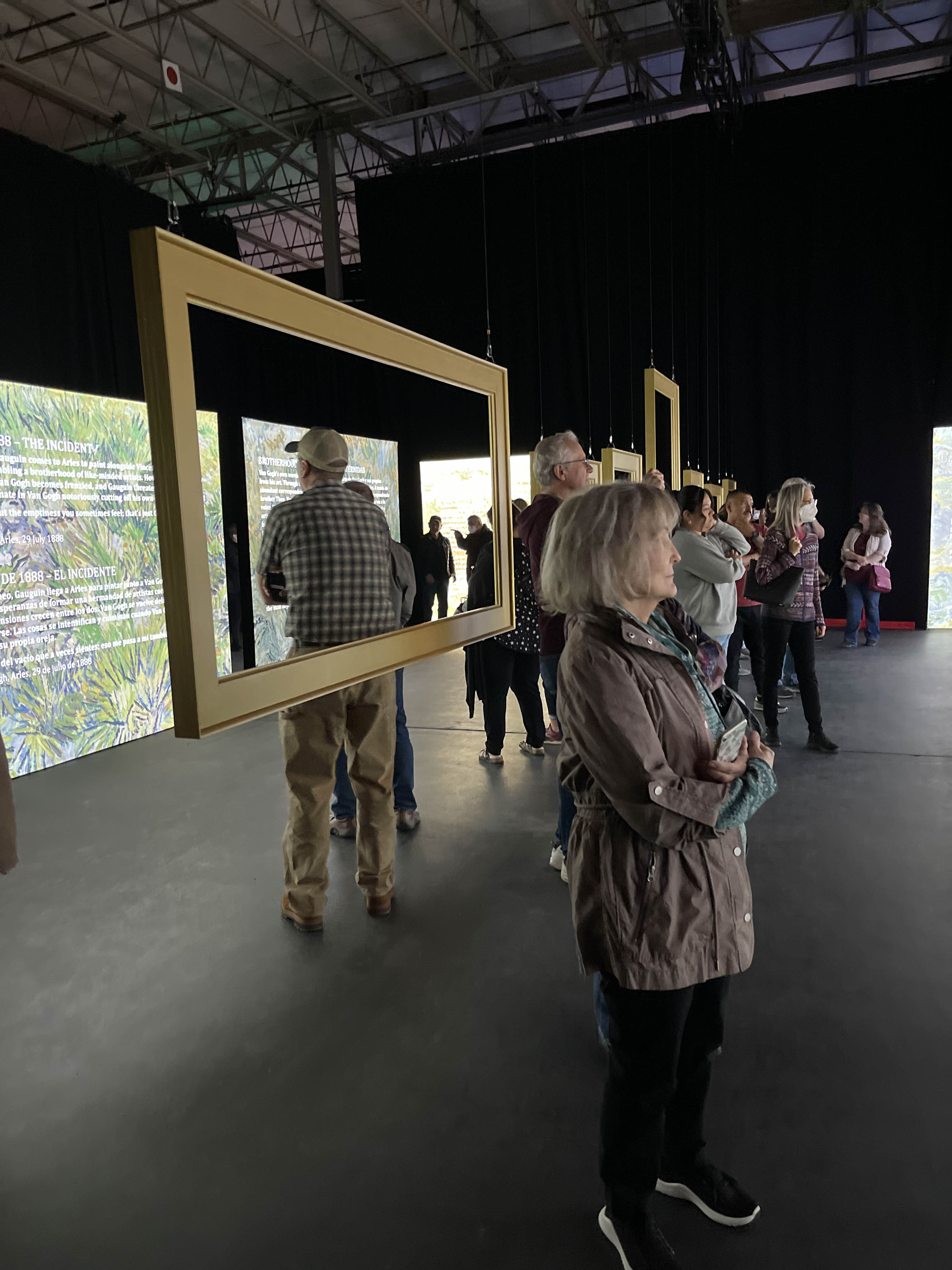
This version is touring as I hope Klimt will. Previously it could be seen for some months in Los Angeles. As we were lucky enough that it came to Albuquerque, I thought that I should have the “Experiential” experience which I gather is “de rigueur” these days. I can tell you, up front, that it is not like standing in front of the original in a museum, but after all it is not intended to be.


We had bought our timed tickets online in advance. When we arrived at the venue, an old factory building, we were instructed to use the facilities before entering, for there were no toilets inside. They put out mobile portoasans which were relatively luxurious with running water.

The women at the exhibition entry were extremely polite answering any questions and explaining that photography and video were encouraged as long a flash was not used. They also wisely explained that one should not lean against the curtains or screens for there were no walls behind them! The first scenes you see are models of small Dutch towns of the kind that van Gogh and his brother Theo came from with huge curlicue clouds suspended above.


Then there are several rows of information panels. Coming from the world of ¾ of a century ago, we are used to reading wall labels but here each written statement was a huge projection with details from van Gogh paintings. We learned, for instance, that Vincent’s brother, Theo, was a successful art dealer and businessman, and it was thanks to his support that Vincent, who had tried other work, was finally allowed to concentrate on his art, as well as other factoids and quotes.


After walking through some curtained blank spaces, you turn a corner and enter the main event. It is a huge open space filled with what, at first, looks like just large still images, until everything starts to move, or at least that is the perception. If, as a child, you enjoyed spinning around until you were dizzy, you will get extra pleasure out of a show like this. It is not so much the that the images on the walls fade in and out, stars twinkle and water undulates but that the brushstrokes dissolve on the floor in continuous moving colors. This contributes to the feeling of total immersion or, if you are susceptible, to vertigo.


There are a few benches, and some visitors sat on the floor, but most people walked around and turned around as all four sides of the space and central columns had images. One couple even decided to dance to the accompanying music.


I asked a gentleman sitting next to me on a bench if he had ever seen an original Van Gogh painting. He asked, “In a museum?” when I replied in the affirmative, he said he had. At one point in the changing projections he said, “Cool” and I suggested that he probably had not said that in front of the far smaller original, he agreed. He loved the space given within the portraits and believed that the sitters looked so real. An interesting reaction since, van Gogh was quoted as saying, “…don’t become a slave to your model…take a model and study it, for otherwise your inspiration won’t take on material form”. Clearly van Gogh had no wish to paint photographic images but rather to capture the essence of his subjects.


When I asked my benchmate for his overall impression of the experience he answered, “Ask me in a week or two”.


Sunday, September 29, 2024

All That Glitters

“The Incas called gold ‘tears of the sun’. The Egyptians knew it as ‘the flesh of the gods’”. Katie White continued in her Artnet column in 2021, “The hue has adorned tributes to deities, marked depictions of kings and queens, and symbolized opulence, power, and otherworldly spiritual splendor.”

Personally, gold for gold’s sake does not move me, though I appreciate artworks where gold has been used to enhance their beauty. The value of gold, however, was brought home to me in a very simple way. I own a few pieces of jewelry by arguably the most important jewelry maker of the Hopi tribe, Charles Loloma. I have seen prices of close to $20,000 for pieces that were nice, but not over the top. So, when an auctioneer who specialized in Native American jewelry was at one of the art fairs, I showed him a piece that I particularly prized and asked what it would bring at auction. He said, between $4,000 and $5,000. When I asked why, he replied that the stones are mounted in silver not gold. Yes, I was disappointed from the point of view of value, but it did not dampen my enjoyment of the work. In many cases, I like silver much more because it is subdued and not glitzy. I am not trying to prove anything. Here is a pendant and buckle by Charles Loloma.


I started to think about it and put “gold” in the search engine for my Missives. There was a string of Missives with the word, exceptional works like medieval objects made for the Church. The gilded silver Arm Reliquary of the Apostles, Hildesheim, ca. 1190 from the Guelph Treasure now in the Cleveland Museum of Art is an example.


Although gold is usually seen to signify wealth and greatness it has always been a source of greed that sometimes results in violence and death. Remember King Midas? When the god Dionysus offered him a wish for anything he wanted, he said he would like everything he touched to turn to gold. This delighted him until he touched his food and drink.

Hearing the word gold, one’s first thought is bullion, jewelry, or maybe a crown, certainly not a painting. But, of course, a painting using gold, on a subconscious level, attracts us by that vibrant color. A painting that has come to be famous as “The Woman in Gold” (1907) is the portrait of Adele Bloch-Bauer by Gustav Klimt, now in the Neue Galerie in New York.


It resided at one time in the Belvedere in Viena, which has retained another great painting, “The Kiss” where Klimt also made use of gold. It is surmised that the painting is a self-portrait of the artist together with his lifelong partner, Emilie Flöge. It is also the last painting he did where he used gold leaf in his work. Picasso had his pink and blue periods but Klimt preferred gold!


If we think about it, this is nothing new. In fact, it is quite an old tradition in European imagery. In the late Medieval and early Renaissance era gold background was used to represent heaven and the proximity to God. A wonderful example of Italian gold ground painting is the panel in the Frick Collection “The Temptation of Christ on the Mountain” (1308-1311) by Duccio die Buoninsegna.


I wish I could explain why gold is a status symbol associated with wealth and power. Looking for reasons I just kept coming across the same answer… because it always has been so, over millennia.

Maybe it is because it glitters!

Sunday, December 6, 2020

The Kiss

I looked at two objects in our collection and though they were created about 100 years apart they stuck me as similar, having   a universal quality and meaning. Their common subject, The Kiss. The Kiss is found in many cultures though it might take on different forms.  When it is on the cheek that could have many meanings, but on the lips … It is surprising that it is rarely depicted.

The first, I have mentioned before so suffice it to say that it is a Katsina group carved by a Hopi artist Ros George around 1995 representing a clown and a fertility Katsina kissing.


The other is an Art Nouveau Inkwell with an intertwined couple kissing as they emerge from ocean waves.  It was created by a Czech Artist, Peter Tereszczuk (1875-1963).  He was an Austrian-Ukrainian sculptor working in Vienna who specialized in small bronzes in the Art Nouveau style. The piece in our collection is an inkwell signed and dated 1900.


Of course, when I said to myself, The Kiss, the most famous came to mind, the sculptures by August Rodin: The Kiss and Eternal Springtime. Both are known in several versions and countless replicas too familiar to illustrate.


Then there is the sculpture by Constantin Brancusi, 1916, limestone, in the Philadelphia Museum. The Romanian modernist sculptor was showing off his proto-cubist style.  I look at it as an introduction to abstraction.  The plaster for this piece was shown in the landmark 1913 Armory Show, of which he had already made several between 1907-1908.


The Art Nouveau period has always been one of my favorites and the greatest proponent in painting might very well be Gustav Klimt. Austrian symbolist painter (1862-1918).  He painted one of the more passionate kisses. The Belvedere Museum in Vienna owns the painting, and it is said that the museum bought the picture before the paint was dry between 1907 and 1908.  The following I have taken whole hog from a website gustave-klimt.com:


"The Kiss" is a ménage of different schools of art. The gold leaf hearkens back to such Byzantine artworks as the mosaics in the Church of San Vitale. The composition of the work reflects the influence of Japanese prints that was also evident in some earlier Impressionist paintings. The contrasting patterns of the two lovers' cloaks reflects the Arts and Crafts movement of the era and overall, Klimt imbued "The Kiss" with elements of his signature Art Nouveau style.” 


I shall finish with a most unusual kiss by Marc Chagall painted in 1915 shortly before the marriage of the artist and his beloved Bella.  I can understand being so in love that you are walking or, maybe, flying on air.  The painting is in the Museum of Modern Art.   Chagall’s muse, Bella, worked hard to discover when his birthday was in order to surprise him and he recorded the event maybe not from a strictly realistic point of view but over the next 23 years, nothing much had changed as you see from the additional photo!  What a wonderful fantasy!


Sunday, April 19, 2015

Guilt and Nazi War Loot

Years ago I went to see the Belvedere Palace in Vienna, an extremely impressive building with beautiful grounds surrounding it.  My only memory of the museum, however, is of one wall with five paintings by Gustav Klimt (1862-1918), the Austrian Symbolist painter who was the most important artist of the Vienna Secession movement.  Little did I know at the time that there was going to be a great deal of contention about the ownership of those pictures.

We went the first day of the showing in Santa Fe of the film, “Woman in Gold”, the story of Maria Altmann (1916-2011) who desired to retrieve her family’s treasures stolen first by the Nazis and then by the Austiran government.  The centerpiece of the wall at the Belvedere was one of the most impressive paintings by the artist representing Altmann’s aunt, Adele Bloch-Bauer (1881-1925).  Bloch-Bauer was one of Klimt’s favorites and the only woman of whom he painted two portraits.

Photo Credit: Assieme (1978)

Adele Bloch-Bauer died at the age of 44 of meningitis in Vienna long before Hitler arrived in Austria.  Her will included a request that her husband leave this particular portrait in his will to the Belvedere Palace.  In 1941, however, the Nazis came and seized all the family’s art eventually murdering the mother and father of Maria Altmann and many other friends and members of her family.  Maria, however, managed to escape Austria with her husband and sister.

Helen Mirren convincingly portrays Maria in the movie, that closely follows the actual case, as she  realizes through press reports that attitudes in Austria and Germany were changing during the second half of the 1990’s. An old friend from Austria recommends her son, a young lawyer. who becomes captivated by the case when he realizes how his family was also affected by the holocaust.  His grandfather was the Austrian composer Arnold Schoenberg.

Though Maria has sworn never to return to Austria she goes back to Vienna with her lawyer where they meet up with an investigative reporter, Hubertus Czernin, who wants to help them and make up for the sins of his father who was a rabid Nazi.  With his help they find the will of Adele Bauer-Bloch’s husband who died in 1945 leaving everything to his two nieces (in fact a nephew was also included).  The Austrian government had interpreted the request by Adele Bloch Bauer that her husband bequeath the portrait to the museum as her will, but the will’s actual wording left the picture to her husband. Since the Nazi’s had taken the painting from the walls of the Bloch-Bauer home in 1941 before he died, the case was that it should be restituted to his legal heirs.

After the Austrian government restitution commission finds against them they return to the U.S. to pursue the case here.  In a precedent setting decision they win the right in the U.S. Supreme Court to be heard in U.S. courts.  Realizing, however, that they cannot afford court costs either in Austria or in the United States, they make a deal to bring the case back to Vienna for arbitration, where Altmann finally wins back the family’s Klimts.  Today the portrait of Adele Bloch-Bauer I can be found in the Neue Galerie in New York.

Along the entire process Maria repeatedly hesitates and sometimes wants to put a halt to the venture altogether.  In a final heart-rending scene in the movie Maria finds that winning brings none of the sense of celebration and relief that she expected, but just the guilt of having escaped and left so many behind to die at the hands of the Nazis.  This hit home with me.  My parents got out of Hitler’s Germany shortly after my father was thrown out of University in 1933, the year before he would have received his doctorate.  He never wanted to speak of it and said only, “I knew when I wasn’t wanted”.  He was 22 years old at the time.  Like many of his friends he wanted to enlist in the U.S. Army but to his further upset he was classified 4F, unable to serve.  He could only join the civil defense and never left the U.S.  His guilt feelings were profound and acknowledged more in what he did not say that what he did.  I hadn’t realized what it meant when I was told as a child that my mother went back to Germany in 1937 to get a wedding dress because she could not afford one and money could not be gotten out of Germany by then.  My grandmother only left after the Anschluss in 1938.

I personally have a case with Germany, which was published in the Wall Street Journal on February 24, 2015:

CLICK TO ENLARGE

My father would never have agreed to it.  He had a philosophy “Lass die Toten ruhen”  ironically translated “leave the dead in peace”. He was grateful to be out of Germany safe with his family and being able to lead a good life.  For me, however, over the last decade it has become a desire to seek justice for my family.  We have been after works of art taken from the family in Germany and The Netherlands and refused at every turn.  Although, in a political decision, we lost before the advisory restitution committee in Germany, since I have partners in the current venture and lawyers who believe in the case, it Is being pursued.

I am not sure why so many movie critics did not care for the “Woman in Gold” though they admit that Helen Mirren as Maria is superb.  She was so good that I truly believed she could have been one of my parents’ refugee friends. One of the critics I read found Maria’s statement that it was not about the money, disingenuous, but I can tell you that while money, of course, is part of the package it is about so much more.  I have learned where my parents really came from and it has opened my eyes to the horror that already started in 1933.  Those who lived through it wish and need to forget, but those that come after must always remember!

Sunday, November 9, 2014

Cubism: The Leonard A. Lauder Collection

I met Ronald Lauder, younger son of Estée Lauder, about 40 years ago when a mutual friend introduced us.  Ronald became a good client over the years collecting French 18th century but mostly the more modern works (i.e. early 20th century) that we handled. The latter usually came to us through private collections we had known for some time.  Ronald often said my brother, Leonard, should come in.  I thought this very nice of him but never expected to have Leonard visit but after some years, sure enough he did.

You have probably read about the fabulous promised gift that Leonard recently made to the Metropolitan Museum, consisting of 81 cubist works of art, but what do you think he started to buy from my family gallery?   French 18th century furniture!  After a few years of collecting he invited me for lunch at his home with the Chief Curator of Decorative Arts at the Louvre and an expert in French 18th century, Daniel Alcouffe.  He was suitably impressed and looked forward to Leonard’s collection becoming a great one in the field.  Unfortunately, shortly thereafter the Lauders started on a different track in the decorative arts.  I did, however, see the beginnings of the collection.  It actually amazed me how well the French 18th century went with the modern works, which included a large incredible painting by Gustav Klimt which I personally coveted. 

I remember when Leonard said to me, “Gerry, how about finding me some Cubist pictures?”  I protested that I did not deal in the field of Cubism.  He said, “Well, you sold my brother one.”  Sure enough Ronald had bought many pictures formerly in the Richard S. Davis collection and when a wonderful Picasso drawing came up from that collection I had immediately offered it to him.  The strange life of pictures: one brother owned a great Gustav Klimt which by logic should be in the other brother’s collection (Ronald is co-founder of the Neue Gallerie that specializes in Austrian Secession pictures); and the marvelous Cubist Picasso is also in the “wrong” place… or is it?

How wonderful that Leonard decided to make this collection a promised gift to the Met and not to the Museum of Modern Art that is already strong in the field.   Even better he did not attach strings to the donation.  Unlike a collection like that of Jack and Belle Linsky that must be shown together in perpetuity or the collection goes to another institution, or the Robert Lehman collection that required loan forms for a work to travel from one side of the museum to the other, the Lauder pictures can be shown wherever they may fit with a given installation.  That is the ultimate charitable gesture when a collector doesn’t feel compelled to keep control of their collection after it is given.

I was delighted to see that the introduction to the Met exhibition is two photo-murals which show the Lauder apartment with Cubist paintings together with French 18th century furniture acquired at Rosenberg & Stiebel.

©The Metropolitan Museum of Art, 2014

The Met exhibition is singular.  It includes the entire promised gift of 81 paintings, drawing and sculptures.  The first room by itself is worth a visit with over a dozen paintings, drawings and a sculpture by Pablo Ruiz y Picasso (1881-1973).  In the first few drawings you see Picasso change his technique from realistic nudes to figures in a Cubist style via imagery borrowed from African art. 

The following gallery is full of pictures by Georges Braque (1882-1963).  Then comes the gallery of the two colleagues together where you see the very clear influence one had on the other, so much so that it not always easy to discern which is which from their pictures.


© 2014 Estate of Pablo Picasso
/ Artists Rights Society (ARS), New York
© 2014 Artists Rights Society (ARS), New York / ADAGP

The story goes that Daniel-Henry Kahnweiler (1884 -1979) the renowned French art dealer (who was born in Germany and treated as an enemy alien by the French during World War I) was going to visit his artist Picasso when he passed the studio of Juan Gris.  Looking through the window he saw one of Gris’ paintings so he went in and asked to see more.  The artist was making his living as an illustrator but Kahnweiler began to subsidize him so that he could concentrate on his painting.  I found “The Man at the Café”, 1914, particularly intriguing.  You see the figure of the man quite clearly in the center of a Cubist world.

© 2014 Artists Rights Society (ARS)

The final room is devoted to Joseph Fernand Henri Léger (1881 – 1955).  He was not only a painter and sculptor but a film maker and is thought by some to be a forerunner of the Pop Art movement.  That is my only justification for never having cared particularly for his work!

There is a major catalog for the exhibition written by the co-curators of the show, Emily Braun, who is Leonard’s personal curator, and Rebecca Rabinow who is Leonard A. Lauder curator of Modern Art at the Met.  Rabinow is in charge of the Leonard A. Lauder Research Center of Modern Art, which he also established at the Museum.

What a wonderful introduction to the growth of the Met’s modern and contemporary collections that will soon to be displayed in the Marcel Breuer building that was the former home of the Whitney Museum.

Sunday, May 1, 2016

The Met Breuer

The new “wing” of the Metropolitan Museum which was built originally as the Whitney Museum by Marcel Breuer (1902-1981) in 1966 has been recently branded as the Met Breuer. When the Whitney decided to build their new landmark building on Gansevoort Street in lower Manhattan a deal was made so that the Met could lease their abandoned space for its modern and contemporary art programs. It is rather strange, therefore, that their first exhibition is basically an Old Master show with some established modern artists at the end. 

In the 1970’s I was asked to testify before congress and my lawyer gave me the following advice.  He said, when asked a question reply, “Thank you so much for asking me that question and then say whatever it is that you wanted to say in the first place”.  I found this to be great advice for my entire life. I feel that must have been what happened here, the curators were asked to prepare a contemporary exhibition and said, we’d be delighted to and then did the show they always wanted to which in this case is, “Unfinished Thoughts Left Visible”.  As an exhibition it wanders all over the place with just too many points to make. The two main themes of the exhibition are paintings that were left unfinished because the artist, for whatever reason, put them aside, and those that were “unfinished” on purpose.  I would claim that in that case they were finished …  but if you are like me and just want to see wonderful pictures and sculptures, it is a fine show!

After I had been looking around for a while, I hear someone call out, “Gerry” and was somewhat startled since during the second half of my life I have been known as Gerald.  Sure enough it was an old friend, Michael Conforti, recently retired director of the Clark Art Institute, who I have known since both our early days in the art world.  He proceeded to say, “I can’t get over the fact that I am at the Whitney” and I realized I had felt the same way.  It is somewhat disorienting when you expect to see a section of Edward Hoppers around the next corner and it is something totally different.  It’s a bit like walking into your own home and seeing a huge spiral staircase and marble floors in front of you!  It took some getting used to and the fact that Leonard Lauder a major donor to the Whitney was one of the main funders for this show didn’t make it any easier.

The idea of unfinished works of art is not a new one but I cannot remember one with as wide a range of some 500 years.  In some cases such as with Jan van Eyck’s (1390-1441) “Saint Barbara” from Antwerp of 1437 it is totally obvious that the picture had not been finished, while the “Vision of St. John” by El Greco (1540-1614)  from the Metropolitan Museum I have been staring at for years and never thought of it as unfinished. My fault?.  The latter is for an altar in a hospital outside Toledo that the art historians believe was cut at the top after damage and they speak of the unfinished sky and the figures floating. At least they admit that it adds to the “mesmerizing quality”, since El Greco is all about atmosphere …


A personal favorite in the show is a bronze relief of St. Jerome done in the 1570’s by Francesco di Giorgio Martini (Siena 1439-1501) and lent by the National Gallery in Washington D.C.   It is pointed out here, and it is clear, that some areas have been highly finished and others left in a rough state.  This is referred to as “non finite aesthetic in sculpture”.


Then there is a small Frans Hals (1582-1666) called “The Smoker” (1523-25) from the Met.  I gather from the label that it is included here because Hals used a rough style of painting which forces one to look from a distance to get its full impact.  I believe that in today’s terms we might say that is what gives it wall power.


J.M.W. Turner (1775-1851) may have left more unfinished paintings than any other well- known artist.  “Sun Setting over a Lake”, lent by the Tate, is one that is extremely unfinished, showing many of the abstract qualities that were so admired by artists like Robert Motherwell and Helen Frankenthaler.  What is not mentioned in the label is that Turner liked to finish his paintings while they were on exhibition finding that they sold better that way… another very contemporary notion.


 One of my favorite artists is Gustav Klimt (1862-1918) besides being a leading member of the Vienna Secession he was the most popular portraitist in Vienna.   His “Posthumous Portrait of Ria Munk III” 1917-18, lent by the Lewis Collection, is of a woman who had committed suicide after being spurned by her lover.  Having produced two portraits that the family did not care for, Klimt himself died before finishing this, the third.


My final image for this Missive is by Pablo Picasso (1881-1973) and even though he is a 20th century artist, he has been referred to as an Old Master.  The artist is represented by a work from the Museum of Modern Art, “The Charnel House” 1944-45. Picasso referred to it as the “massacre” and when you look at the dates and think of the Spanish Civil War followed by World War II and the holocaust, the picture is not surprising.  Picasso used charcoal to draw his picture and only after he had finished applied paint.  He considered the picture finished enough to donate it to The National Association of Veterans of the Resistance in 1946 but asked for it back again in the same year, ostensibly to make changes.  He kept the painting in his studio until 1954 when he sold it to an American collector having made hardly any changes at all.

There are some more contemporary images in the show but the Met Breuer does not live up to its hype for being the contemporary art showcase for the Met.  Upon reflection I am very happy about that since we have a number of museums in town already fulfilling that function.

Monday, November 16, 2009

A Wonderful Exhibition

I saw recently a wonderful exhibition about an art dealer who was a collector, a showman and an exhibitionist.

Oh no, you are getting the wrong impression. Serge Sabarsky (1912-1996) not only showcased the Austrian art he so loved in his Madison Avenue gallery, but he also organized exhibitions that were presented all over the world. He was actually first an actor and stage designer in his home town of Vienna. As he told it, he found his love of art when he went to the dentist at the age of 10. He first saw the erotic watercolors of Egon Schiele on the wall of the dentist’s office and he was hooked for life. After that his mother could never understand why he didn’t complain about going to see the dentist!

The exhibition celebrating his life and his collection is at a gem of a museum in New York, “The Neue Galerie” (www.neuegalerie.org) which focuses on the art at the turn of the last century in Germany and Austria. The museum was founded by Serge and his great friend and patron, Ronald Lauder. Together they did a beautiful conversion of a 1914 mansion where Mrs. Cornelius Vanderbilt lll once lived.

The exhibition includes Sabarsky’s great private collection of paintings, drawings, prints and posters by such artists as Schiele, Klimt, Kubin, Kokoschka, and Kandinsky. But be sure reserve 20 minutes for the film (shown in a continuous loop) about Serge as told by him and his friends.

If you have time, treat yourself to lunch or tea on the ground floor of the museum at New York’s only conditerei; The Sabarsky Café, so aptly named after a great raconteur and gourmet.

Sunday, May 24, 2026

Two Museums Join Forces

If you live in New York or have an interest in the art world, you are almost sure to have heard about the merger agreement between the Metropolitan Museum and The Neue Galerie. The Neue Galerie will remain in its present location but under the auspices of the Met as of 2028. The story of how such things come about often seems obvious in hindsight, but rarely is at the time. Although the Met is world-renowned, not everybody knows about The Neue Galerie. The latter is a gem of a museum that specializes in German and Austrian art of the early 20th century. Its star attraction is Gustav Klimt’s portrait of Adele Bloch-Bauer, better known as the Woman in Gold.


The Neue Galerie is going to celebrate its 25th anniversary later this year when it reopens after renovations over the summer. It was founded by an unusual duo. Ronald Lauder, son of Estée Lauder, who founded the eponymous cosmetics firm, and a Viennese art dealer by the name of Serge Sabarsky. The Sabarsky gallery was located on the street level of Madison Avenue at 77th Street. Ronald walked by often and fell in love with the art that Sabarsky displayed in the window and along the gallery walls. Ronald’s daughter, Aerin Lauder Zinterhofer, tells the story best in an article in Vogue magazine. “When I was little, my father used to walk me to Serge’s gallery. He would say to my mother, ‘I’m going to take Aerin to the park,’ and we would go to the park and then end up at Serge’s for hours and hours. I would color while they were discussing their dream of having a museum of Austrian and German art”. (Image Serge Caption: Serge Sabarsky and Ronald Lauder)

Serge Sabarsky and Ronald Lauder

Aerin went on to explain that Ronald not only has known the director of the Met, Max Hollein, for many years, but also was friendly with Max’s father. In fact, the Vienna-born Met Director has been a trustee of the Neue Galerie for the past 20 years.

Ronald S. Lauder, Aerin Lauder Zinterhofer, Max Hollein, & Renée Price


In the interest of total transparency, I was personally friendly with Serge, and Ronald was an important client of our gallery, Rosenberg & Stiebel, as well as a friend. Serge confirmed to me his ambition to create a museum of art in his field. Most friends pull out photos of their children when they see you, but in Serge’s case, he always showed me photos of the buildings he and Ronald were looking at as possibilities for their dream. In the end, it came to be the William Starr Miller mansion at 86th Street and Fifth Avenue, an ideal location on Museum Mile.


On the announcement of the merger, Ronald stated in a letter emailed to the members of The Neue Galerie, “None of this would have been possible without the dedication of Renée Price, the Neue Galerie’s founding and longtime director. I first met Renée in the 1970’s when she was gallery director for Serge Sabarsky”. The three of them made quite a team, but sadly, Serge died before the opening of the Museum. Ronald, however, did the most wonderful and appropriate thing in naming the restaurant on the Museum’s ground floor, The Café Sabarsky. It is more than a Café because it is a serious restaurant, but it has the aura of a typical Viennese Café as well as the food you would expect to find there. My favorites are the Weisswurst and the Sacher torte. Nowhere else in this country can you find this sausage or cake as good as in Austria or Germany. The reason I believe it is so appropriate is that Serge loved telling stories, and I can visualize him sitting in a corner of his café telling stories to all who would listen.


I will end with one of his favorite jokes. The waiter brings him the soup he has ordered, and before the waiter can put it down, he says, “It’s not hot enough. Take it back.” A few minutes later, the waiter returns with the soup. Without hesitation, the patron repeats, “It’s not hot enough. Take it back”. After this happens a couple of more times the waiter, by now quite annoyed, says “You don’t look up. You don’t try the soup. How can you know it is not hot enough and when do you think it will be hot enough?” He replies, “When you have to carry the soup on a saucer and a tray instead of with you thumb in the bowl”.

Sunday, March 6, 2016

Inuit Art

It is amazing how short a time social media such as Facebook  has been with us and it has totally changed our lives.  More than once have I been introduced to people “virtually”.  The first time it happened I wasn’t even sure what it meant.  A dealer from New York met a collector from Santa Fe in Paris and knowing I lived there introduced us by email.  If I had gotten a phone call or letter that someone from Santa Fe had been at the fair I would not have wanted to get in touch for fear of imposing.  Yet, we have now become friends in Santa Fe.

It happened again last year when a wonderful Cherokee Basket weaver, Shan Goshorn sent an email saying in part, “Please may I introduce a friend of mine to you? Like you, he is an astute collector who also writes about native art and the art world. He is a retired teacher from NYC where he still resides and will attend Indian market next month, I believe for the first time.”  His name is Edd Guarino.   We did not meet that summer though we did correspond through email.  A couple of weeks ago, however, he came into the Ralph T. Coe Foundation, where I volunteer, brought by a friend of the Foundation President, Rachel Wixom.  He had come for the opening of an exhibition of works on paper from his collection of Inuit Art showing at the Museum of Contemporary Indian Art (MOCNA).

I became aware of Inuit Art when I visited my son, Danny, in Traverse City Michigan.  Needless to say, we went to the local museum, The Dennos, and their strongest collection is from the Baffin Island area of Nunavut, Canada.  It includes a 1,000 prints, sculptures, drawings tools and textiles.  Funnily enough I only remember prints and drawings in black and white.   There is probably much more but nothing else there particularly intrigued me.

I was most pleasantly surprised when Edd took me into his exhibition,  "Akunnittinni: A Kinngait Family Portrait".  There was color everywhere and fascinating subjects.  The exhibition offers a visual conversation between an Inuk grandmother, mother, and daughter – Pitseolak Ashoona (1904-1983), Napachie Pootoogook (1938-2002), and Annie Pootoogook (1969- ).   The matriarch bore her husband 17 children had to bring them up on her own after he died.  She settled in Cape Dorset where she was a pioneer draughtsman creating 9,000 drawings within 20 years!   “Family Camping in Tuniq Ruins”, 1976.  stonecut and  stencil, lent by Dorset Fine Arts, is typical of her intricate works of art.  I must say that I needed the title attached though I am sure that a Native would have understood the symbolism.


Pitseolak was encouraged to concentrate her art on community rather than the individual “Migration Towards our Summer Camp”, 1984, lithograph lent by Dorset Fine Arts,  if you like me were brought up on the East Coast think of an Indian camp not summer camp in Maine.  This is one of her last works and reminds me of the African-American Migration Series by Jacob Lawrence.


As in so many Native Families it is not just one member who is an artist but it becomes a tradition and even a dynasty of artists.  No exception here.  Many of Pitsolak’s progeny became artists and one of her daughters Napachie Pootoogook is represented here.  I love this lithograph of 1989 titled, “Nascopie Reef”  from Edd’s collection who supplied the following 3 images.  We don’t need any more information to realize how dangerous that reef is and of all the boats that have broken up on it.  The remaining images are courtesy of Edward J. Guarino.


I wrote the last paragraph before receiving the backstory, which Edd sent me: “Nascopie Reef documents an historic episode in the life of Cape Dorset residents.  The people of Cape Dorset depended on the supply ship Nascopie to bring them goods to get them through the winter.  In July, 1947 the R. M. S. Nascopie hit a reef off Cape Dorset.  The citizens of the town rushed out to the ship to try to get as much off of it before it sank, knowing that it carried the only supplies they would see all year.  Without them they could not make it through the winter.  This event was so traumatic that it is still vivid in the minds of the people of Cape Dorset so much so that a number of artists have created works that reference this incident.” I thought this an excellent example of how if the work of art is successful the history is not necessary though it helps to expand our knowledge.

Napachie’s daughter Annie is more involved in family than community.  The drawing of her grandmother, Pitseolak, is a woman we all know instinctively.  It is a sympathetic portrait of an older person.  Do note the child peeking in on the right side in this image of everyday family life “Drinking Tea”.


My last image by Annie, “Couple Sleeping” 2002-2003, a drawing with pencil, crayon and ink, shows a major progression in style using color as much as draughtsmanship  to depict the scene.  Gustav Klimt at the beginning of the last century used color similarly to form his subject.


I am asked why I continue to do these Missives week after week numbering well over 300 by now and there are two simple answers.  One is that if I stop even for a week I feel I may never start again and the other is that every week I am able to learn something new or at least get a fresh insight into another world.