Sunday, April 17, 2022

Beyond Van Gogh

“Beyond Van Gogh” is the same concept as Immersive Klimt which I wrote about a couple of months ago:

https://www.geraldstiebel.com/search?q=klimt

This version is touring as I hope Klimt will. Previously it could be seen for some months in Los Angeles. As we were lucky enough that it came to Albuquerque, I thought that I should have the “Experiential” experience which I gather is “de rigueur” these days. I can tell you, up front, that it is not like standing in front of the original in a museum, but after all it is not intended to be.

We had bought our timed tickets online in advance. When we arrived at the venue, an old factory building, we were instructed to use the facilities before entering, for there were no toilets inside. They put out mobile portoasans which were relatively luxurious with running water.

The women at the exhibition entry were extremely polite answering any questions and explaining that photography and video were encouraged as long a flash was not used. They also wisely explained that one should not lean against the curtains or screens for there were no walls behind them! The first scenes you see are models of small Dutch towns of the kind that van Gogh and his brother Theo came from with huge curlicue clouds suspended above.


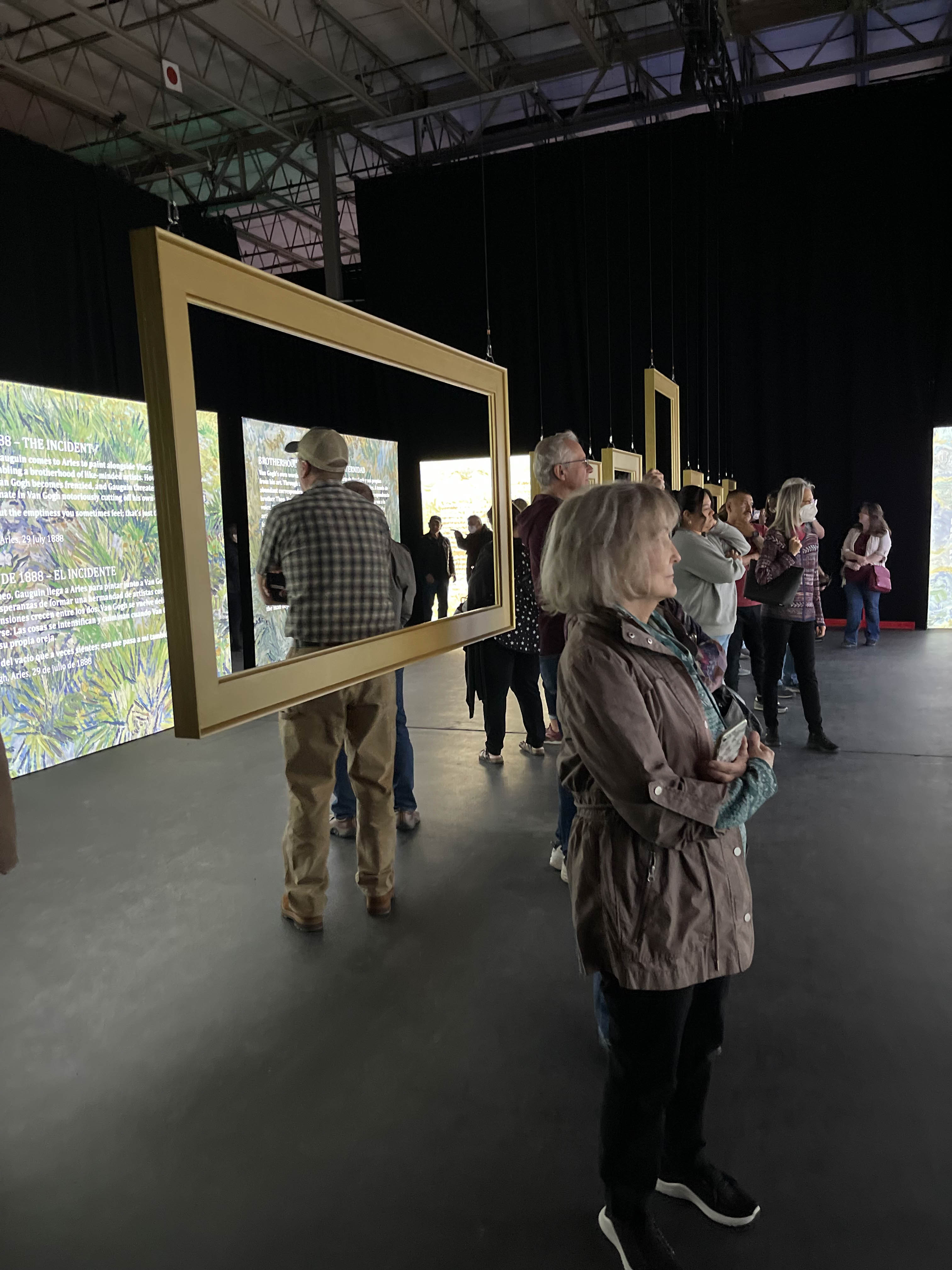
Then there are several rows of information panels. Coming from the world of ¾ of a century ago, we are used to reading wall labels but here each written statement was a huge projection with details from van Gogh paintings. We learned, for instance, that Vincent’s brother, Theo, was a successful art dealer and businessman, and it was thanks to his support that Vincent, who had tried other work, was finally allowed to concentrate on his art, as well as other factoids and quotes.


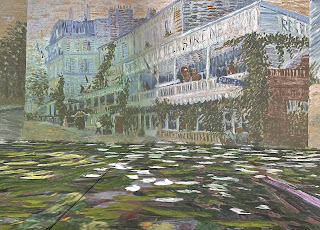
After walking through some curtained blank spaces, you turn a corner and enter the main event. It is a huge open space filled with what, at first, looks like just large still images, until everything starts to move, or at least that is the perception. If, as a child, you enjoyed spinning around until you were dizzy, you will get extra pleasure out of a show like this. It is not so much the that the images on the walls fade in and out, stars twinkle and water undulates but that the brushstrokes dissolve on the floor in continuous moving colors. This contributes to the feeling of total immersion or, if you are susceptible, to vertigo.


There are a few benches, and some visitors sat on the floor, but most people walked around and turned around as all four sides of the space and central columns had images. One couple even decided to dance to the accompanying music.


I asked a gentleman sitting next to me on a bench if he had ever seen an original Van Gogh painting. He asked, “In a museum?” when I replied in the affirmative, he said he had. At one point in the changing projections he said, “Cool” and I suggested that he probably had not said that in front of the far smaller original, he agreed. He loved the space given within the portraits and believed that the sitters looked so real. An interesting reaction since, van Gogh was quoted as saying, “…don’t become a slave to your model…take a model and study it, for otherwise your inspiration won’t take on material form”. Clearly van Gogh had no wish to paint photographic images but rather to capture the essence of his subjects.


When I asked my benchmate for his overall impression of the experience he answered, “Ask me in a week or two”.


Sunday, April 10, 2022

Monet/Rothko

Love the idea of gallery hopping virtually and that is just what I was doing when I saw an announcement from the Hotel Drouot, the Paris auction house that hosts a number of auctioneers from different companies. Following up on one of its news stories I found the announcement of a Monet/Rothko exhibition at Le Musée des Impressionnismes Giverny, the village 45 minutes from Paris, where Claude Monet made his home and garden which has become a must for all lovers of the Impressionists.

Monet/Rothko seemed like a most unusual pairing until I started looking into it it and found it so interesting to see them side by side. I am sorry that I won’t be viewing the exhibition in person which will close on July 3.

Claude Monet, Weeping Willow, 1920 -1922, d’Orsay Museum,
Paris and Mark Rothko, Light Red Over Black, 1957, Tate, London

Claude Monet (1840-1926) was born in Paris and lived in France his entire life except for two years (1860-61) in the French Army posted in Algeria. Mark Rothko was born Markus Yakovlevich Rothkowitz in Latvia, which at the time was part of Russia. He came with his father to the United States at the age of 10. Rothko did travel, not only back to Latvia but to many European countries including France.

Looking into the influencers for Mark Rothko (1903-1970) I found artists from Michelangelo to Klee. It would be easier to list who did not influence him! He was strongly impacted by the paintings of Rembrandt and Fra Angelico. He preferred Monet to Cezanne and upon visiting a Turner exhibition was quoted as jokingly saying “This man Turner, he learned a lot from me”. He was clearly highly educated and interested in mythology, Christian iconography and philosophers such as Friedrich Nietzsche.

The Return of the Prodigal Son, ca. 1668, The Hermitage; Rothko,
No. 210 No. 211, 1960, Crystal Bridges Museum of American Art

From the above paragraph you won’t be surprised that, in common with Monet, Rothko was not satisfied with what art school had to offer and changed his style often. Though Rothko has always been identified as an Abstract Expressionist he would deny it later in life. Monet, toward the end of his life, became more and more of a colorist and his images became less and less representational.

The comparisons between Monet and Rothko are not new and recent scholarship has shown that late Impressionism had a great influence on the Abstract Expressionists. Rothko was fascinated with the light in the Impressionists’ work but used it in a much more forceful manner.

Claude Monet, Tributary of the Seine near Giverny, 1897,
Paris, d’Orsay Museum Paris; Mark Rothko, Untitled,
1957, National Gallery of Art, Washington D.C.


According to the commentary on the website of Normandie tourism “While Monet seeks to convey the immediacy of a feeling, Rothko attempts a more intense approach, where contemplation expands thought. Connecting Mark Rothko and Claude Monet means inviting the public to a visual and sensory experience. Visitor’s eyes, but also their perception of space and time, are subjected to an original artistic test…. Where the fleeting impression of the moment was Monet’s obsession, Rothko diluted space in the time of observation. Vertigo or contemplation, the exhibition will let the public find another perception of abstraction and modernity.”

This may be a bit too much art speak, but it is hard to make the comparisons in other ways since much is about one’s reaction to the art and is difficult to explain. I have written about Rothko several times and for me he has a mystical quality which fits in very well with the later work of Monet. What is so wonderful about art is that you don’t have to understand what the scholars and art historians say: it’s not science and your personal reaction is just as good as the next person’s.

Monet/Rothko is a small show, as exhibitions go, with just 6 works by each artist but it is an effective way to make a single point so viewers can contemplate the thesis and come to their own conclusions.

Sunday, April 3, 2022

Art, a Clandestine CIA Operation

As I mentioned last week, I am listening to a book called, “Aftermath” by Harald Jähner about Germany after World War II. When Germany was split among the Allies into 3 zones, British, American and Russian. Berlin became the demarcation zone where the Russian, East Germany and Allies, West Germany met. The country only became one again in 1989 when the Berlin wall came down.

The Day the Berlin Wall Came Down

Hitler considered himself an artist and took his inspiration from the classics. He hated anything that one could refer to as modern and called it a degenerate product of Jews and Bolsheviks and a threat to the German national identity. In 1937, the Nazis confiscated 16,000 paintings from the German museums and put 650 of them one view in his “Degenerate Art” Exhibition. What Sotheby’s and Christies would give today to have that sale!


Needless to say, there was quite a difference between democratic ideals of the West and the autocratic systems of the Russian-dominated communist states of Eastern Europe. Without the state dictating taste Germans, in the western sector, were allowed to make their own choices of what they liked and did not like. This sudden freedom of choice became a voracious appetite for the new, and abstract art became a method of denazification.

In 1946 the State Department put on an exhibition titled “Advancing American Art” composed of 117 works of art it had purchased representing modernist trends. It was to show those abroad that the U.S. had a culture worthy of attention, and to counter our image as war mongers after atomic bombs were used in Japan. The President Harry Truman’s reaction to the show, however, was no help when he famously declared, “if this is art, I’m a Hottentot”. The press, led by Hearst newspapers lambasted the show with headlines such as “Your Money Bought these Paintings”. In the end the State Department had to sell the art. The exhibition, however, had already toured in Eastern Europe and Cuba and the genie could not be put back in the bottle.

West Germany and much of Europe related to the work of Abstract Expressionists like Jackson Pollock as their work was seen as an explosion of assertive individualism in reaction to the restraints of social realism. Congress, of course, was way too conservative to be willing to support such an outlandish concept. They called the abstract artists “Heretical Daubers”, so the CIA decided that to encourage openness, they had to work in secret! Members of a group within the CIA became art dealers arranging exhibitions abroad. Sometimes they turned to the Museum of Modern Art, in order to bring exciting works by Pollock, Robert Motherwell, Mark Rothko and Barnet Newman to a new audience.

Jackson Pollock, Number 1A,
1948, Museum of Modern Art, New York

In his book “Aftermath” Jahner uses the career of Juro Kubicek (1906-1970) to illustrate the American program of influence through art. Kubicek had avoided the stigma of “degenerate art” by supporting himself as a commercial artist during the Nazi era. He emerged after 1945 as one of Berlin’s Fantasist painters and he caught the attention of an Allied official who was the President of the University of Louisville. In 1949 he was invited to teach and study at the University. When he returned to Berlin he opened a Work and Art Studio in Amerikahaus, a U.S. funded institution where Germans and Austrians could learn more about American culture and politics. At Amerikahaus he taught not only painting but applied arts that could be incorporated into the home. He used his American connections to organize numerous exhibitions and went on to become a professor at the Berlin Academy of Fine Arts.

Amerikahaus, Berlin 1946

Music, movies, literature. Any form of the arts you can think of were used to break down the ingrown narrowmindedness that had been enforced by the Nazi regime. There was an appetite for fresh ideas particularly in the younger generation who had known nothing else. The arts were to prove to be one of the most effective weapons in penetrating the Soviet Iron Curtain and ending the Cold War.

Sunday, March 27, 2022

Facing History

As the son of German refugees who left their homeland thanks to Hitler, I approach the subject of Germany in the immediate post World War II period with trepidation. Though l like much about Germany and their products (I drive a BMW) still I have this fear of learning too much.

Yet I am now listening to “Aftermath” an English translation audiobook by the former editor of the Berlin Times, Harald Jähner. It looks at the difficult time after the War when the German people had to come to grips with their past. I recommend the book although the material is not easy.

Millions of German soldiers and civilians died in World War II. Cities were reduced to the rubble as we are beginning to see in Ukraine. In his book Jähner describes conditions in post-War Germany conditions where as many as six plus unrelated people had to share a small apartment. Women and children left behind sometimes did not even recognize their husbands and fathers when they returned. Even women whose husbands survived often felt that the men abandoned them. How to face this, when together with the hardships there was shame at losing.


As history museums the world over are interpreters of the past, the book inspired me to look at how those in Germany deal with the post war period. It is particularly difficult for them as many if not most Germans have ties to the old world as well as a conscience which will not allow them to forget. Two new museums have been established specifically to face the issues caused by the Third Reich.

In 2015 a new museum opened in Munich, called the “Documentation Center for the History of National Socialism”. Years ago we were reminded that the beautiful city was the birthplace of Naziism when we dined in a restaurant which we learned was Hitler’s favorite. The location of the new institution is fraught with memories and blame as it is at the same address as the former Brown House, the building that served as Nazi Party headquarters from 1930 through the end of World War II. It was here that Hitler planned the Holocaust. The modern design of the building was an intentional demonstration of the city’s and Germany’s break with the past, yet inside is evidence of the horrible truth of that past. There have been many who objected to being reminded including a group Neo-Nazis who staged a protest at the museum’s inauguration.


Last summer A new museum opened in Berlin called, “The Documentation Centre for Displacement, Expulsion and Reconciliation” thirteen years after Chancellor Angela Merkel’s government gave the go ahead for its creation. There was much debate but Merkel prevailed saying it “fills a gap in our coming to terms with history.”


According to EuroNews Between 1944 and 1950, some 14 million Germans fled or were ejected from today's Poland, Russia, the Czech Republic, Hungary, the Baltic states, Romania, Slovakia and the former Yugoslavia, escaping the Soviets or pushed by the Allies. When they returned, their former homes had disappeared in the rubble. The new Berlin museum paves a way to help Germans trace family histories and the evils that had been perpetrated in their name. The exhibits are all items that people took with them as they fled. An example of which is a girl's leather pouch marked with her old address Adolf Hitler Strasse 36 in Fraustadt, now the Polish town of Wschowa: It is displayed in a case near a well-thumbed Hebrew dictionary.

Both of these new history museums take on broad themes. The Munich Documentation Center examines the history of the city before, during and after WWII, and also attempts to tackle the ongoing topics of exclusion, racism, anti-Semitism and discrimination. Berlin’s Center for Displacement, Expulsion, Reconciliation, in the words of museum DirectorGundula Bavendamm, addresses “forced migration as a phenomenon of modern Europe”. Today’s news reports estimating 3.5 million refugees from the Ukraine provide yet another tragic example.


Sunday, March 20, 2022

Artists Help Ukraine

I don’t believe any of us can, or should, get away from the subject of Ukraine.

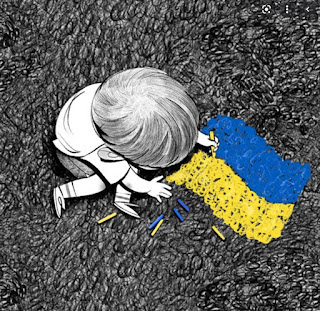
I have been reading more about how artists are reacting and trying to do something to protest the war and help the Ukrainians.

Tom Booth

After World War II a member of the French Resistance became a film maker whose nom de guerre was Jean-Pierre Melville. Four years after V-E day he made a film called “Le Silence de la mer”. In the film a German Officer billeted in a French home and an admirer of the city who had enjoyed the famous sights such as Notre Dame and the Arc de Triomphe, meets with his superiors who inform him that the Nazi plans are not just to destroy the might of France but its spirit as well. What better way than to destroy the monuments and art that people come from around the world to see.

As I have mentioned in an earlier Missive the Ukrainians are doing what they can to shelter the art and artifacts in their museums, but it seems inevitable that much will be damaged or worse, destroyed. Keeping all of this in mind, cultural heritage professionals – librarians, archivists, researchers, and programmers are working to preserve digitally, Ukrainian civilization before Russia can destroy it. They end with a plea, ‘You can still help by submitting URLs” of sites containing Ukrainian Cultural content. They can also use help from those who speak Ukrainian or Russian.

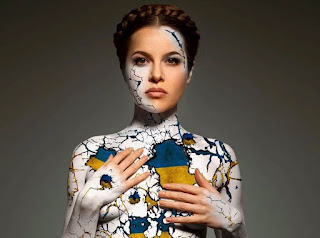
Needless to say, Ukrainians are speaking out through their art. An artist by the name of Yuliana who is both a photographer and painter created what she called “the indestructible spirit of Ukraine”. She told a reporter from NPR that the woman’s body may appear to be cracked but the Ukrainian flag shined beneath the gaps. There are many such stories showing the incredible spirit of and belief in their country.

Yuliana

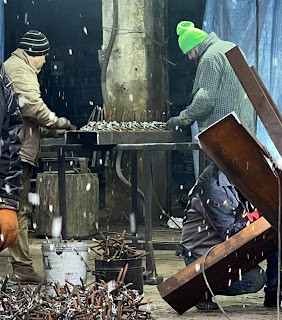
The most dramatic story I read was that a Ukrainian artist, Volo Bevza, travelled from his home in Berlin, to Kyiv last month for an opening of his exhibition at the WT Foundation, a museum set up by American collector Walter Tamke. It was to open February 24 but never did and Bevza ended up in the middle of a war zone. He had travelled with his girlfriend Victoria Pidust, a photographer, and her younger brother Mark. For safety’s sake they headed to the city of Lviv which was father west but did not leave Ukraine as one might expect. Instead, they started to make the jagged Czech Hedgehogs which are being made to stop the rolling tanks. They have not been invented for this war but were first used at the Czech-German border during World War II. Now the artists have been raising funds for both defense and humanitarian aid by asking for contributions from artists, dealers and collectors from their homes in Germany. Victoria Pidust recorded the activity.

Czech Hedgehogs

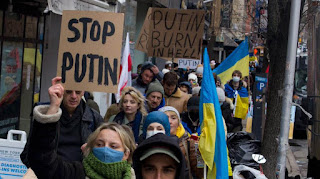
Artists the world over, including in Russia, are demonstrating in the streets in support of Ukraine. What might surprise you is the report from the Great Falls Tribune of Helena, Montana that a local artist is donating the proceeds of her work to help Ukraine. Svitlana immigrated from the Ukraine to the States in 2017 after her marriage. She is working from the Mountain Sage Art Gallery selling her hand painted scarves, jewelry, and watercolors to buy food, clothing and medicine for the people and refugees in her native city of Poltava. She started a website selling the concept, come buy my art to help the people of Ukraine. She plans to donate 80% and keep 20% to cover the tax liability for her sales. In the first week she had $4,000 to contribute to the people of Poltava. She has put one caveat on her contributions, that is her donations not be used to acquire weapons but to take care of the people.

I picked the story above because I would not have associated the situation in Ukraine with the formerly wild west state of Montana whose motto "Oro y Plata", Spanish for "Gold and Silver", harkens back to when mining ruled the state. But much of the worlds’, artists, galleries and auction houses are selling art in the fight for right. From what we have read and seen from Ukraine they could adopt New Hampshire’s state motto, “Live Free or Die”!

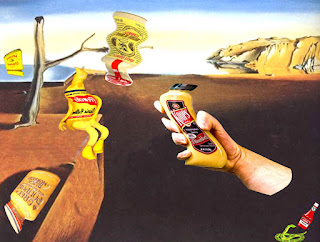
To end on a lighter note Sarah Rose Sharp announced in Hyperallergic, “National Mustard Museum Banishes Russian Mustards” The Middleton Wisconsin museum announced that the Russian mustards would return “once the invasion of Ukraine is over and Russia recognizes and respects the sovereign nation of Ukraine”. Here in a parody of Salvador Dali’s “Persistence of Memory”.

Persistence of Mustard

Sunday, March 13, 2022

An Economic Art Surprise

With foreshadowing long before the battles in the Ukraine began and the news getting worse and worse everyone has been concerned about the effects on the economy of every country.

As you know, my interests have always been related to the arts so I was wondering what effect the current situation would have on the art market. No companies were more concerned than the auction houses.

There are a plethora of auction houses in the world but the ones that get the most press are multinational companies and in particular Christie’s and Sotheby’s, with Phillips not that far behind in England. Needless to say, there was plenty of anxiety about the major sales taking place last week during London’s recent auction week.

Phillips had a couple of big strikes against it since it is owned by two Russians through their luxury conglomerate Mercury Group. Their CEO, Stephen Brooks, spent quite a number of days on the phone assuring owners, consigners and representatives that that the owners, Leonid Fridlyand and Leonid Strunin, were not the subjects of sanctions and had no connections with those who did. Finally, Phillips agreed to donate their commissions on the entire March 3rd evening sale to the Ukraine Red Cross which in the end yielded $7.7 million dollars in proceeds. Sometimes what starts out badly ends up for the good.

There were other reasons for concern. Within the EU there are laws in many countries that require businesses to identify the ultimate beneficiaries of limited liability companies, trusts and private foundations to protect against money laundering and, in this case, to check on sanctioned individuals. At the same time some of the oligarchs were ready to dump their art for cash. Suffice it to say there were many hurdles to surmount. Some fabulous works of art came on to the auction block and they did just fine, proving that so far the art market is very robust.

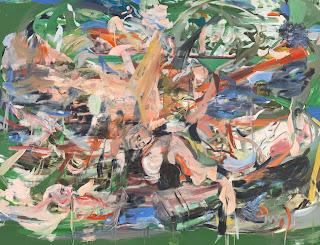
Phillips ended their sale of Contemporary and Modern art with a total of $40 million. In spite of the last-minute withdrawal of 5 lots, 95% of the lots actually sold. There were a few third-party guarantees, meaning that there were individuals who would pay X if the bidding fell below that figure. While established artists brought good prices even better than the estimates, the most active bidding was for the up-and-coming contemporary artists. A 2016 abstract composition based on Géricault’s “Raft of the Medusa” by British Artist Cecily Brown and titled “When Time Ran Out” came in just over its high estimate to sell for a bit over $4 million.


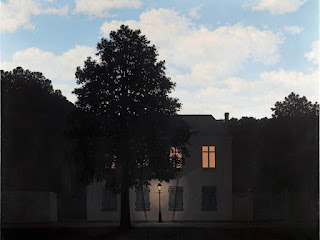
Sotheby’s highlight at their evening sale on March 2 was René Magritte’s “L’Empire des Lumières”. Estimated at over $60 million it brought $79,422,000 including Sotheby’s commission.


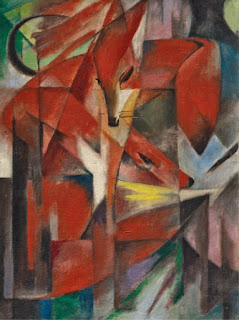
Everyone at Christies had to be holding their breath for their March 1st evening sale. It was their first auction with their new Shanghai gallery, live streamed from London and mainland China and incorporating Hong Kong and New York. This was a sale of 20th and 21st century works of art. The bottom line … it worked. However, it did have some showstoppers to whet the appetite. A restituted Frans Marc of 1913 called “The Foxes” brought $57 million which was more than double the artist’s former record price.


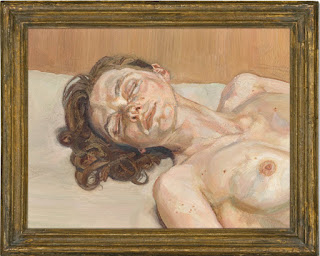
I must say I am a sucker for the artist Lucien Freud and Christies had one I loved in the same sale,“Girl with Closed Eyes”, (1986-87) It sold for just under $20 million.


Even in this time of geopolitical crisis art seems to be retaining its value.


Sunday, March 6, 2022

Art & War

Even though our troops are not involved the war between Russia and Ukraine seems close to home probably because we have thought of Russia as the rival if not the enemy of the U.S. for most of our lives. Now war could reach our shores if not by violence then by the newest weapon, cyber-attacks, not to mention the fact that last week Putin put his nuclear forces on high alert.

What I have not thought about that much is how do you protect art from the indiscriminate bombing and mortar shells? Of course, I should have remembered the devastation of art collections and historical monuments in Iraq and Afghanistan not to mention World War II.


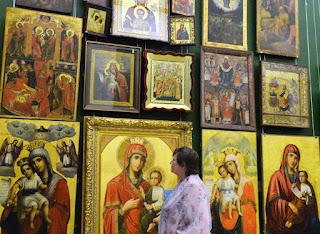
Statistics show that there are 5,000 museums in the Ukraine as opposed to 35,000 in the U.S. Of course, these are not all art museums but still the number represents a whole lot of art including archeological objects. Of course, the safety of art comes second to the safety of people but without the art and artifacts a nation loses its history. Erasing the concept of Ukrainian culture may be the intent as Russia attempts to take over a country that at one time was part of its empire and make it part of Russia again.


The Russians already burned down a museum in the province of Kyiv which housed the work of an internationally recognized Ukrainian folk artist, Maria Pryimachenko (1919-1997) and 25 of her paintings were destroyed. Upon seeing an exhibition of her work in Paris Picasso is said to have commented, ““I bow down before the artistic miracle of this brilliant Ukrainian.”


What to do particularly when you are concerned for your family, friends, and staff? The director of the Museum of the History of Ukraine in the Second World War said that in “a great feat” the staff had moved the most important pieces to a “safe location”… and where might that be? I presume bomb shelters are for people not art.

Of course, the Ukrainians are trying to secure their museums and the Odessa Art Museum has put up barbed wire around the museum which might stop looters but won’t do much against a direct attack or bombing. To mitigate the latter, art has been moved to the safest place within the walls of the museum, the basement. The Lviv Municipal Art Center near the Polish border took a different direction: it has opened its doors to those fleeing the war zone to offer “a place of temporary respite for displaced people and for all those who require psychological calm.”

The art world is reacting. The Royal Opera House in London has cancelled the Bolshoi Ballet appearance this season. Artists are withdrawing works of art lent for Russian exhibitions. One curator has demanded that an exhibition he organized be closed immediately but, in the maelstrom, international loans are held hostage until ways can be found to return them.

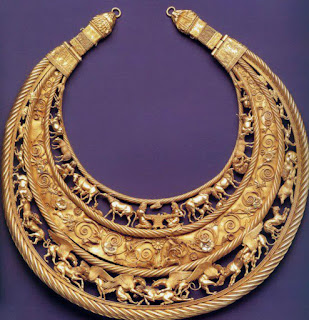
Can Ukraine’s patrimony of treasures, which includes Scythian gold, be transported out of the country for safe keeping? This, of course, would be one solution. In spite of the imminent danger the law must still be obeyed and to move art over the border one must get government permission. At least one museum that had applied to do so as tensions rose had still not received a government release when the invasion began. Here is a pectoral, ca. mid 4th century, from Tovsta Mohyla, Ukraine.


Patty Gerstenblith, professor at DePaul University and director of its Center for Art, Museum & Cultural Heritage Law, recently urged the Western art market to self-police against the illegal trade of looted Ukrainian artworks and archaeological artifacts. Easier said than done, if the art trade had adhered to that admonition during and after WWII there would be few fewer claims today for the art looted by the Nazis.

Communication with the outside world is difficult but museum staff have been able to do so on social media. Eventually, when it is all over, we will learn what art has been preserved and how it was done, but for now all we can do is pray the brave museum directors and curators of Ukraine survive and succeed in their mission.