Sunday, August 27, 2023

Lazy Days of Summer ??? ... Cont’d

Our Indian Market Week started off at a gala for the Institute of American Indian Arts (IAIA) and their scholarship fund. IAIA is a public tribal land-grant college in Santa Fe focusing on the arts. It’s President, Robert Martin, explained that they want each student to graduate with no student debt. I have found that generally people open their wallets wider when the subject is the education of students and this evening’s auction and paddle call were extremely successful. (For any who have managed not to attend this sort of fundraiser, a paddle call is when the Master of Ceremonies calls out the dollar number and audience members raise their paddles to contribute in that amount.) 

There must have been 400 diners that evening. The auctioneer started out with $20,000 and went as low as $250. When $20,000 was called out one attendee shouted, “I want to give more”. He was not ignored and when asked how much more, he said he wished to donate $100,000 to the scholarship fund. That started things off with a bang. This kind of figure is very rarely seen here with such a small population and so many cultural institutions seeking support.

The SWAIA (Southwestern Association for Indian Arts) Indian Market which is the climax of Santa Fe’s “season” happens once a year on the third weekend in August. Native Americans come from all over to show and sell their work. This year’s Market seemed larger than ever. According to the local newspaper, “The New Mexican”, this year there were 800 artists from 250 Indian Nations i.e. Federally recognized Tribes.

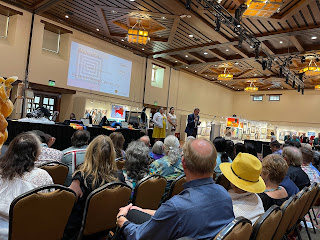
Before Market begins there is a Best of Show Ceremony and luncheon. Artists who wish to compete for the prizes bring their works to the Community Center for judging. Ribbons are awarded by panels of judges according to media, for technical excellence and nowadays for innovation. Competing artists, volunteers and those paying to attend the luncheon can inspect the first prize winners in each category set up on a dais where the artists are called up to receive their awards. The audience is seated for the division award presentations with anticipation building for the Best In Show announcement.

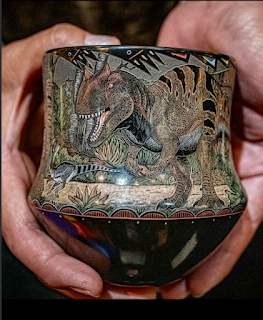
This year the top prize went to a small pot with graffiti decoration of dinosaurs by Jennifer Tafoya (Santa Clara Pueblo). Hardly traditional, the award was as a surprise to all, including the artist who, unlike other winners, was left speechless. Here she is holding her prize winner.

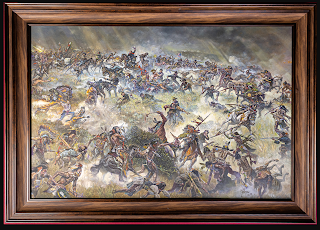
What wins Best of Show and other first prizes usually sell immediately when Market opens the next morning. A fabulous painting by Dan HorseChief (Pawnee/Cherokee) representing the battle the artist titles, "Judgement Day Manifest, The Greasy Grass 1876 Keough's Stand." Anglos call it the Battle of Little Big Horn or Custer’s last stand. The artist, after a great deal of research, believes that what actually happened is the army of the west were not outnumbered but outsmarted by the Indians using their hunting tactics. We tried to find the artist the next day at market and failed. Quite possibly he did not bother sitting in a booth because his one creation was sold right away. Here is his painting photographed by Tira Howard.

For the luncheon which is outside the Convention Center one has to either be an invited competitor or spend a pretty penny to attend. We are in the latter category but usually find interesting people to sit with. This year a Native lawyer and author joined our table and as she spoke with an Anglo couple from Arizona that was already seated, they found they had gone to the same elementary and high schools in Santa Fe and had mutual friends from fifty years earlier.

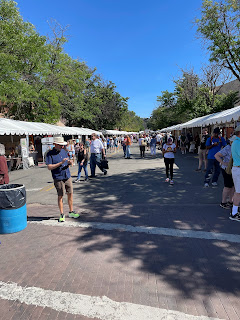
Even though, we spent 3 hours the following day, Saturday, touring Indian Market and another 2 hours on Sunday I know we did not see everything. We collect very little these days since our house has hardly an inch of wall or table space that is not covered with Native American Art. We have actually given some pieces to museums including the Metropolitan in New York. So, we looked at a lot but did not linger except at booths where we had become friends with the artists in the past. Here is an image of just one street of booths, multiply by 4 and you will have some idea of how large the market is.

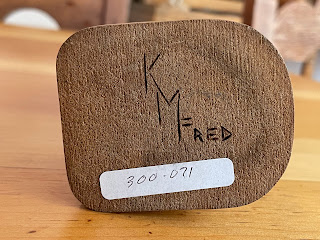
Having said that we no longer collect is not quite accurate. I am on the Board of the Wheelwright Museum of the American Indian in Santa Fe, which had a benefit sale earlier in the week. I was manning a table that included baskets and carved katsina figures that represent the spirits of the Hopi religion. Sure enough, I fell in love with one of the latter, actually not a katsina but one of the human clowns that appears during the Katsina dances. It is beautifully carved and the face has such a great expression. Behind his back you can see he is holding a cigarette which is clearly a no no. Not mentioned on the label was the mark on the bottom which we were able to trace to the carver’s family through friends more familiar with the field than we are.


These last two weeks have certainly not been Lazy but rather tiring! Still, it is a wonderful opportunity to participate in community and get together with friends and neighbors in common cause.

Sunday, August 20, 2023

Lazy Days of Summer ???

We always hear about the lazy days of summer. Whoever came up with that myth? If you live in a tourist town, a destination place that is pleasant in the summer months it is the other way around.

Particularly this year when so many locations are far too hot and others far too wet, we see lots of visitors here at 7,000 feet in Santa Fe, New Mexico. We have lots of sunshine but not extreme temperatures and a dearth of rain. This wonderful weather and the beautiful skies and mountain scenery are reasons in themselves to visit.

The summer also brings music from the famous Santa Fe Opera in its modern partially outdoor theater to the Chamber Music Festival. The Lensic Theater has added the Lensic 360 program which includes free concerts on the Santa Fe Plaza and in other venues around town.


Fairs abound and surround. It starts in July with Folk Art Market, bringing artisans from around the world. That is followed a couple of weeks later by Spanish Market. These events happen over weekends. We skipped the folk-art market this year but went to Spanish Market which showcases the local Hispanic traditions. We are not collectors in this field but once in a while we are tempted. One year, being culturally Jewish and my wife born into the Christian faith, we bought this straw work cross, inlaid with a Menorah and a Jewish Star. The artist, Charlie Sanchez, explained that his village of Tomé, NM, was settled by Sephardic Jews fleeing the Inquisition.


August started off with the second year of the 2-day Lighting Boy Foundation Competition of Native youngsters from 4-year-olds to virtuosos in their 20’s. Here is last year’s Missive about the Hoop Dancers: 

https://www.geraldstiebel.com/2022/08/the-hoop-dance-and-lightning-boy.html

This year I took some shots of the younger set trying their abilities ...


Then this past week brought dealers in ethnographic arts in two established fairs which we always called “Old Indian Market” although material from other parts of the world is included. The one we are most interested in is the Whitehawk fair which this year packed more dealers than ever into the Community Center downtown. They used to serve food for the $100 opening night, but it seems that since another company has bought the fair, so no food but many more dealers packed into narrow aisles. Nonetheless, the quality was as high as can be expected in any fair.


One stand was occupied by the Mexican Jewelry designer Frederico Jimenez. He sells his own creations as well as other Mexican silver and there is always such a crowd at that he has his good friend, a local Santa Fe celebrity, working with him. I managed a grab shot of her. Does she look familiar? Think “Love Story”.

Ali McGraw

Penelope picked out her “Best of Show” which was also not Native American. It was an exquisite Chinese embroidered coat lined in white fur on the stand of Sheila Ellis who sold it opening night. Actually, it was nice to see a lot of business being done, the collectors were back.


Another event that we went to was Feast Day at Santa Clara Pueblo which was open to the public for the first time in 3 years. There are 3 plazas on which 3 different groups danced in sequence. If you are lucky enough to have received an invitation you will bring some food for your host and be served a feast. When we arrived, we were reminded that photography is not allowed at these events and told to leave our phones in the car. I asked one of the many policemen, both tribal and BIA (Bureau of Indian Affairs) what would happen if I was caught with the phone. I was told the phone would be confiscated and I would have to appear before a tribal Judge during the week and pay a fine to retrieve it.

This coming week will be even busier with Native American events which you can read about here next week.

Sunday, August 13, 2023

Li-Sense

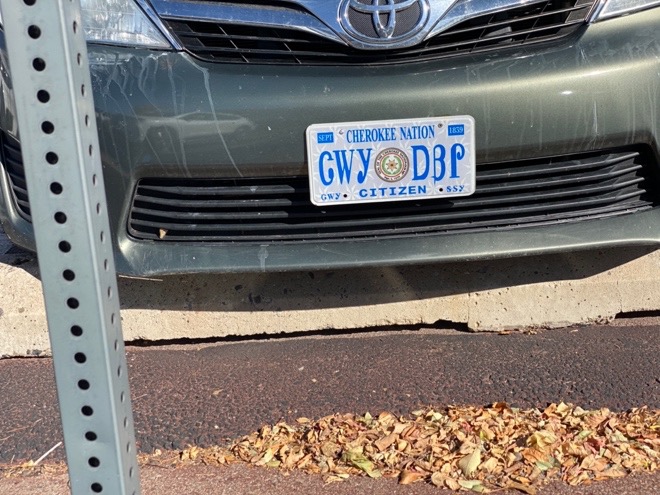
This is my car which sports a word from the Hopi language meaning Anglo (whiteman). From here my story continues ...


Could this car belong to Mrs. James Bond?


Could she be following this guy?


Commie sympathizer? Can she ...


Now that he has stopped at the ...


The next morning, he went to Indian Country ...


Might be time to ...


We better watch out for ...


This is not like chasing ...


Oh no ... was somebody shot?


Please ...


Readers comment ...


This is for next week ... meanwhile ...


Monday, August 7, 2023

Roxanne Swentzell and Her Heritage

In 1997 I met a woman from Santa Clara Pueblo who changed my world view, the late Rina Swentzell, a Santa Clara potter, a teacher, an author, an architectural historian and a lecturer.

https://www.geraldstiebel.com/2016/04/rinas-gone-1939-2015.html

The other night we heard a talk by her daughter Roxanne Swentzell (b.1962-) an eminent pottery artist. She had asked what subject she should address as she might well have lectured on Permaculture as she is an active proponent of, “the conscious design and maintenance of agriculturally productive ecosystems which have the diversity, stability, and resilience of natural ecosystems.” For this audience however the organizer asked her to address her art.

Roxanne creates figural sculptures and her primary medium is clay. I wrote about the importance of clay in the Pueblo culture some months ago.

https://www.geraldstiebel.com/2022/08/grounded-in-clay-tradition.html

One of Roxanne’s most monumental pieces was commissioned in 2008 for the Santa Fe Community Civic Center and according to their website is 14 feet in diameter. The title is “Family”. At the time when she was asked about her choice of subject she replied, “If I were given one image to capture the "seed" or beginnings of this state of community consciousness, it would be a child born within an extended family in which they come around him/her in total support.” (Images of “Family” and Creating Family)


Roxanne explained that due to a medical issue as a child she was very late in beginning to speak. From the age of 3 she made clay figurines as her means of communication, a skill she learned from her mother. The extenuated hands and feet that are part of her mature work continue to be a way she expresses herself. Think of who you know who speaks with their hands.


I loved the story she told of her mother driving all the kids somewhere and suddenly stopping on the side of the road and telling her children to take off their socks so she could use them to collect mud (clay) for her pots.

Another of Roxanne’s monumental sculptures, “Mud Woman Rolls On” (2010-2011), was created for the Denver Art Museum. It is almost 11 feet tall, and she explained that she had to make it of adobe, straw wattles mixed in the clay, to support the weight. She collected the clay along the way up to Denver, a five-and-a-half-hour drive.


Two major themes in her work are mothers and children. In her presentation Roxanne spoke of women of the earth. She stated, “Clay is our mother” and repeatedly referred to “remembering the mother”.


Roxanne and her mother, Rena, built Roxanne’s Tower gallery off the main highway north of Santa Fe with the same adobe used for “Mud Woman Rolls On”. Here is the finished gallery with a cast bronze by Roxanne; and Rina working on the building.


Near the end of her talk Roxanne quoted her mother speaking of “An Understated Sacredness” in working with clay. I am going to end where I began, with her mother, Rena. In order to understand where Roxanne has come from and how her work expresses that culture, when you have time, spend 18 minutes listening to the PBS episode where her mother speaks of the world from the Pueblo point of view and the lessons that it holds for us today.

Sunday, July 30, 2023

The Price of Admission

I am an idealist and believe in helping those who need support in their daily lives, due to no fault of their own. But this is not a Missive about taking care of the poor but rather helping those who love the arts but cannot afford to see them.

I asked Google why art is important and found four billion six hundred and ninety million responses, No, I did not read them all but just a few and I liked the one on top best: “Art is important in our cultural and social lives because it is the medium through which we process our emotions and ideas. It is also an important tool for learning, teaching, and communicating.” We know it has always existed because as soon as fire was discovered there were paintings on the walls of caves and non- utalitran objects created even before that.

My question is why do many museums charge for the privilege of experiencing art first hand.

In order to learn history or art one needs to know what came before. Artists need to be able to view all they can before they can be inspired and make innovative statements. Before Picasso arrived at Cubism, he had studied the paintings of Spanish Old Masters in the Prado. Before the Dutch artist, Piet Mondrian, painted his grids, he had mastered the traditions of Dutch landscape art. Here is an early Mondrian from the Beyeler Foundation and one of his grids.


Art is a vital part of life and the museum is a port of entry. While I have written and others have said that museums are a small corner of the entertainment industry, it is not a momentary diversion or a brief escape like a movie, but a life enhancing experience. Yet, it is less expensive to buy a ticket to a movie than to enter many, if not most, major museums.

The Metropolitan Museum has an annual operating budget of approximately $300 million and an endowment with a current market value of about $4 billion. At their gala this year the museum raised 17.4 million dollars. Yet an individual who wishes to pay a single visit while passing through must pay an entry fee of $25.


What made me think of this is the announcement that the Whitney Museum of American Art in New York is now raising their entry fee from $25 to $30.

According to a listing in Artnews more than 200 art museums in the United States offer free admission, including of course the federally subsidized National Gallery. Even for institutions that do not receive direct government funding, their tax exempt status allows the wealthy to deduct their contributions from their taxes.

Though I believe we all benefit from direct exposure to works of art, those who most need to go to art museums are the artists, art students and art educators. From the news we know that the college degree is a way to get in the door but you only learn your trade on the job. Degree or no degree the artist learns from how others have worked through the ages. To avoid the adage that there is nothing new under the sun, show me what came before. Let the artist learn from past examples the visions, techniques, and tricks of the trade to adopt, adapt or reject.


Granted New York city is one of the most expensive parts of the country but in relative terms museum fees can be a barrier to entry. An article by Colleen Dilenschneider, chief market engagement officer for IMPACTS, which claims to be “ a global leader in predictive market intelligence” compares the average annual household income of individuals who went to the Zoo, Aquarium, Science Museum, History Museum and Art Museum. You might be surprised, or not, that those with the highest income, between $71-72,000, went to the art museum.

While all statistics can be interpreted differently, could it have something to do with the cost of entry? According to income categories I could find on line, the earnings of few professional artists reach that category.

Maybe the museums should look at whether their sources of funding other than an entrance charge could cover their operating costs. Surely access should not be restricted to those who can afford to enter their “hallowed halls”.

Sunday, July 23, 2023

Museums and Social Media

Museums, as a general rule, are not the most up to date in the realm of technology and certainly not in the use of social media. But as they are finding that it brings in more visitors, that is beginning to change. I believe it is an unintentional consequence of the pandemic. Just like restaurants thought of building more outdoor spaces, museums started doing lectures and panels on Zoom and then started to use social media to keep the larger audience that they had gained. Here are postings from the Museum of Illusion ...


I heard from an artist that he gets most of his information about what is going on in the art world from YouTube. That surprised me. Then I read from a website I had never heard of, makeuseof.com, “Thanks to its Community posts and commenting features, YouTube shares even more similarities with traditional social media platforms like Facebook, Twitter, and Instagram.”

Here in our relatively small town with a large disproportionate number of museums and galleries several do post video recordings of their lectures and panels on YouTube. They have found it works in keeping their public interested.

The School of Advanced Research in Santa Fe is devoted to the study of anthropology and related disciplines with an emphasis on Native American artists with an important collection in that field. This is their YouTube channel 

https://www.youtube.com/@sarsantafemultimedia

It seems that The Art Newspaper keeps track of the most popular art museums on social media every year. In an article by Aimee Dawson with research conducted by Chinma Johnson-Nwosu it mentions that for some reason the Hermitage in St. Petersburg, Russia has slipped out of the top 20. I don’t know why, though I can guess, but it does say something about how social media works. The article does not say whether the museum tried to get followers just that it did not get as many. The premise is how many followers did the museum receive through their efforts. The one with lowest number of the top 20, having 1,550,777 followers, is the Guggenheim Museum in Bibao. The Museum of Modern Art in New York is at the top of the list with 13,346,854 followers. The next ones down are the Metropolitan Museum and the Tate in London, both having over 10 million. The Louvre comes in 4th with over 9 million. Of course, those large numbers come from the best-known museums around the world. These figures are a huge jump for social media from before the Pandemic.

You may already know that there is a new game in town challenging Twitter. Actually, there are several, but the one I believe most likely to succeed is “Threads”. Meta, aka FaceBook, has thrown its hat into the ring. One of the first art institutions to take make a move there is the Whitney Museum of American Art.

The person in charge of the Whitney’s Threads account is Casey Betts who started the account which Annie Armstrong on Artnet News called a quip-centric approach posting “weird contemporary art”. Betts said, “It actually fits in with our larger social media strategy, which is to reach as many people as possible. If the way to do that is to be more light in tone or be more casual, then this is a great opportunity to explore a voice that’s different than what we’d do on either Instagram or even TikTok.” Here are a couple of examples ...


I am excited at the prospect of some toning down of the serious, highbrow attitude toward art in favor of posting in a lighter vernacular to show that art is for everybody and readers do not have to feel ignorant or be scared of it.

Sunday, July 16, 2023

Art History vs. History

Don’t study art history if you are looking for an accurate account of history. You can’t rely on art any more than any other form of documentation and often less so. Art historians want us to believe according to the Courtauld Institute “it is a way of understanding the world”. It does teach some things, but you can’t take a work of art at face value.

During the American Revolution Washington crossed the Delaware on Christmas day in 1776. The event was memorialized 75 years later in the iconic painting by Emanuel Leutze. The painting includes numerous historical inaccuracies, even to the American flag which was only adopted at the Continental Congress on June 14, 1777. An account in the on-line publication Purdue Today, points out, however, that the purpose of the painting was not to document an event but to inspire liberal reformers during the European Revolutions of 1848. So much for relying on art for historical accuracy.


The advent of Abstract Expressionism has been dated precisely as beginning in 1946, inspired by the turmoil created by World War II . But abstract art dates earlier. The website of the Tate Museum in London, gives the definition “Abstract art is art that does not attempt to represent an accurate depiction of a visual reality but instead use shapes, colours, forms and gestural marks to achieve its effect.” A 2017 article by Abigail Cain in Artsy titled “When Picasso Almost Invented Abstract Painting” discusses claims to the advent of abstract art. Here is an image of a “Woman in a Chemise in an Armchair” in the Met by Picasso 1913-1914 painted well before the Wilhelm de Kooning, dated 1952-53, “Woman and Bicycle” at the Whitney, which one looks more abstract to you?


According to a publication BestLife, in 2007 Stanford University’s “Digital Michelangelo Project” discovered that if you view Michelangelo’s triple life-size David from below, he appears to have a calm and confident look but looking at his face straight on he seems rather tense about battling Goliath. Does it tell us anything of consequence? It is something amusing to cogitate but hardly an art historical discovery.


The devil is in the details not in the broad strokes of what seems obvious. New revelations may contradict what has been published and accepted in the past. What exists below the surface?

In a recent article by Richard Whiddington we read: “Henry VIII endures in the history books as a ruthless king with a cantankerous temperament.” Following a jousting accident in 1536 Henry spent the last decade of his life in great pain and believed it was a punishment by God. In his bible he marked several paragraphs and one of those says, “Take away thy plagues from me …” and another, “god forsake me not …” But a less cocksure man emerges in the margins of his own prayer books.” Royal portraits generally portray a confident, strong ruler but it should be noted that, after all, the artist must please his patron, not document reality.


If you wish to learn history a work of art can be helpful in filling in the blanks and understanding it better, but it is not reliable in revealing the human condition. As Benjamin Franklin was purported to have said, "Believe none of what you hear and believe half of what you see".