Sunday, November 28, 2021

Color and Black & White

No, this is not a blog about photography but about some very real issues politically and socially and how they play out in the art world. Last month I wrote about the 1971 acquisition of the portrait by Velazquez of Juan de Pareja by the Metropolitan Museum of Art.

What has changed since then?

For one thing, like everyone else who watches television we have noticed how many people of color are now featured in commercials. Then there is a television series started in 2016, “Lucifer”, where the hero from hell, i.e. the devil, (Tom Ellis) is played by a white individual, while his brother, an angel, (D.B. Woodside), is played by a black man. If you’ll excuse the expression, “what a contrast”. We find that these two disparate characters are underneath, extremely similar.

Quite rightly we are being acclimatized to equality of color and the sexes. As the younger generation who are still being molded into maturity, hopefully more will become both color blind and less sexist. It has been pointed out to me that there are now more female anchor people on television, albeit in the daytime and at night more male. It would seem that the networks are catering to their perceived audiences as to when more women or men watch the telly ...

The staid museums come a bit late to the party but slowly and surely they too are realizing their lack of inclusiveness. I learned something interesting after writing the Pareja Missive from Nancy Hoving, widow of the then Director of the Metropolitan Museum, Thomas Hoving. She wrote, “Looking at all the great painting and painters we see today I can't figure out where (TH) and I were. Kerry James Marshall and others were around but we never saw them. I can’t understand how this happened because I know (TH) would have liked him as much as I do. And there are others.” In 2015 the Met did finally buy a painting by the artist of his Studio. It was painted in 2014 and acquiered through the art dealer David Zwirner. The Met then followed up with a Marshall retrospective the year after.
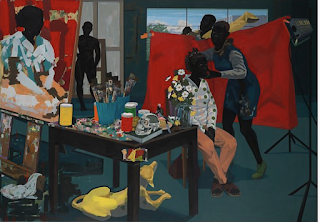

Why? It would be easy to say that the museum curators were just not interested or was it that the name dealers who they relied on were not showing art by people of color. Of course, there were many below 57th street but that was a country away.

I also wonder whether it was thought of as appropriate that the art of the other be in a separate museum. Who knows? “They” had their own museum such as the Studio Museum in Harlem. From their website: “The Studio Museum in Harlem was founded in 1968 by a diverse group of artists, community activists and philanthropists who envisioned a new kind of museum that not only displays artwork but also supports artists and arts education.”

Another example of this concept one might call euphemistically, separate but equal is The Museum of the American Indian/Heye Foundation which was established by wealthy collector George Gustav Heye in 1908. Heye began collecting American Indian art as early as 1897. His collection rapidly increased over the next several years but was devoted to traditional tribal material. Only since it became the National Museum of the American Indian in 1989/96 did it expand its focus to contemporary work.

My father who started out his life as a strictly orthodox Jew and only became conservative after his son was born as he did not want him to be extreme in this democratic country. He did not support the Jewish Museum because he said there was no such thing as Jewish art. Art was art far as he was concerned. Maybe it is because of that last bit I too believe all art is equal and paintings are paintings, furniture is furniture and jewelry is jewelry, etc. and sometimes they may rise to the exulted heights of the current definition of art.

Art is a reflection of people and their life experience. Visitors to museums can ask how works of art by artists of different ethnicities relate to their life experience. What better way to teach than to show the different approaches that African American, Native American or Japanese Artists see the world or even similar subject matter?

Traditionally our encyclopedic museums turn out to be a series of separate fiefdoms each of which are separate but not equal. The galleries that get the most space are often the European Paintings and the Chinese art or African art are given less gallery space. You can mix those priorities in a different order for different museums but the attitude is that never the twain shall meet. You hear people visit just one section of a museum never being exposed to another. In my opinion the main galleries should have a mixture of cultures then you can have sections that specialize for those who wish to concentrate on a specific field. I am pleased to say that the Metropolitan Museum’s relatively new Director, Max Hollein is now encouraging curators to communicate with those in other departments to this end.

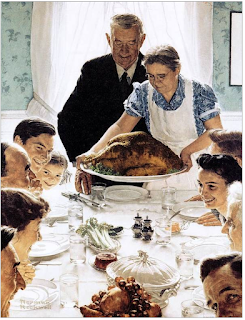
Just think of how thought provoking it would be to see the Anglo traditional image of Thanksgiving by Norman Rockwell and this one by Paula Peters, a member of the Mashpee Wampanoag tribe. Members of the tribe gathered near Plymouth Rock in 1991 for a day of mourning in response to the Pilgrims’ Thanksgiving.

Suzanne Kreiter—The Boston Globe


Sunday, November 21, 2021

The Strange Lives of Works of Art

I have written on similar subjects before but am always fascinated how works of art have lives of their own. Often it is just a question of moving from collection to collection be it private or public. Over time any work of art may not seem as desirable as it did when first acquired. Private collectors may deaccession for financial need or a change of taste. In our case, our former collections did not seem to fit our lifestyle in Santa Fe as they did in New York.

Even museums wish or must sell from their storerooms. A museum may acquire a work from a donor in hopes of getting more from them. Later on, it may be felt that the donation is not of the caliber of other works in the collection or better examples have been obtained. So, the original donation goes into storage and when it reaches the bottom of the ladder, or the museum no longer needs so many similar works, it gets deaccessioned for the next collector to acquire.

But there are other ways in which works of art have their own lives. What prompted this Missive is an article I read last week, entitled “The Girl with a Pearl Earing’s Lavish Jewel May be a Fake and 4 Other Secrets Scholars Have Uncovered in the Work of Vermeer”. What word stuck in your mind from that long title? I will bet it was the word “fake”! Sometimes I don’t concentrate enough when I read and I read the title, as I would bet many others did, that the painting was a fake. That is not what the article said, but it did get your attention.


The article goes on about how the most popular painting in the Mauritshuis in the Hague and four other Vermeers may have been altered or “edited”, either by the artist himself or others later in some cases because of possible suggestions of impropriety. For example, The Girl Standing at the Window reading a letter in the Museum in Dresden, when cleaned revealed the painting of a cupid on the wall which might imply that the girl at the window was reading a love letter from a suitor. In 17th century Holland that might have been considered scandalous. Does that make the picture worth more or make it more attractive? The good and evil is in the mind of the beholder, and it depends on the standards of the era.

Here are images of the painting before cleaning and after.


Sorry, this is not an issue of fakes but part of the history of the paintings. In the case of “The Girl with A Pearl Earring” jewelry experts said the pearl was too big to be an authentic jewel of Vermeer’s time. Happily, the few brush strokes that enlarged the pearl have been found to be consistent with the artist’s highlighting. From a dealer’s point of view, this kind of question would affect the value if this painting were on the market. If a buyer were to think the pearl had been enhanced later to make it more prominent, he might not want to pay the “full” price of a Vermeer. The senior partner of my gallery, Saemy Rosenberg of Rosenberg & Stiebel used to say in German, “They can kill you with their science”. Which certainly could be true as far as value is concerned.

What should a museum do if a painting in their collection is called a fake or painted by a less important artist? I have probably mentioned before the “Polish Rider” by Rembrandt in the Frick Collection. The “experts” decided at one point that the picture was not by Rembrandt, but the Frick, in a courageous act, refused to take it off wall. Low and behold, the next experts came around to once again fully attribute the picture to Rembrandt.


Also revealed recently is that Jacques Louis David’s portrait of Antoine Laurent Lavoisier and Marie Anne Lavoisier, donated by Jayne & Charles Wrightsman to the Metropolitan Museum in 1978 had also been reworked. This was done by the artist because of the changing politics of the time. I will let you read the Met’s analysis for yourselves and see the transformation in the painting.

https://www.metmuseum.org/perspectives/articles/2021/9/david-lavoisier-conservation

There are so many more examples of revising art history through scientific discovery. Whether this is progress or just disturbing the status quo is up to your own way of thinking and possibly your age as well!

Sunday, November 14, 2021

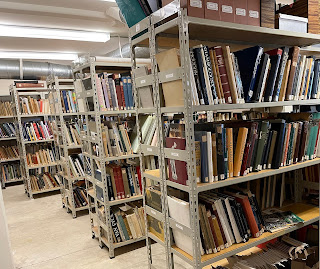
The Library is Leaving

Almost exactly a decade ago I wrote a Missive titled “The Library Arrives”

https://www.geraldstiebel.com/2011/06/library-arrives.html

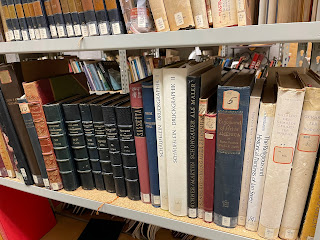
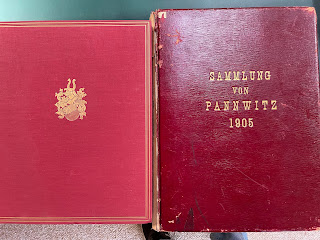
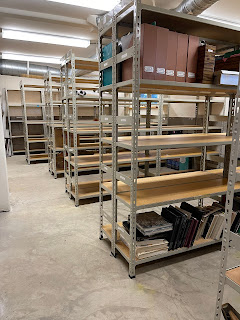
A couple of months ago I wrote about deaccessioning not only my gallery archive but also our art history library. Now it is happening! 


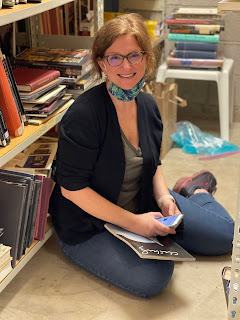
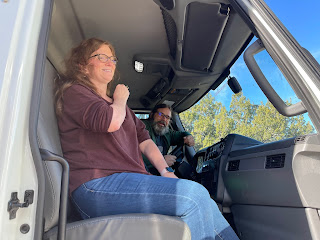
The library is on its way to the Birmingham Museum of art. We meet the librarian, Laura Woodard from the Birmingham Museum of art at the Albuquerque airport. Next morning, she picks up a huge rental truck from Penske then settles in to check which books will go in addition to those already listed.


My wife and I have a last-minute panic that we can’t part with this book or that.


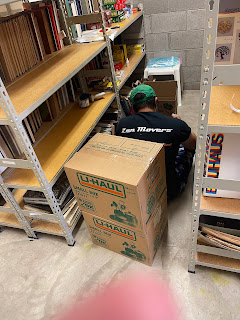
Four fellows from Zen Movers come to begin packing the books in our basement as well as in our studio:


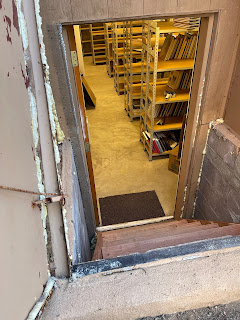
Coming up from the basement library with the packed and taped book boxes they begin loading the truck. The cartons are so heavy they need to bring the dollies up the ramp backward onto the truck.


While we thought the job would take 3 days or more, but the men finish in 7 hours.


The next morning Laura with her friend, renowned keyboard artist Matt Slocum, take off for the 18 hour drive back to Birmingham.


Sunday, November 7, 2021

The Thanksgiving Play

The other night we went to the theater for a play, a treat we have had precious little of in the last 18 months other than in the box in our TV room.

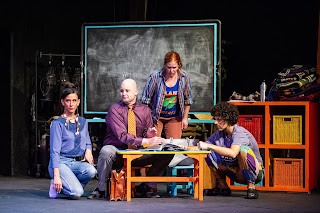
Up front, I need to mention that it was an extra pleasure because our son was in the play. This is not a review; however, I am sure you are well aware that any theater piece that one’s son or daughter are in, is perfection. Here is the cast from left to right, Kate Bergeron as Logan (the teacher) – Patrick MacDonald as Caden (the Professor) - Jess Haring as Alicia (the actress) and Hunter Hans Stiebel as Jaxton (Logan’s Paramour).


What interests me for the purpose of this Missive is the concept and ideas behind the play. “The Thanksgiving Play” is a comedy written in 2015 by a Native American, Larissa FastHorse, who had received the coveted MacArthur Genius Grant. It has been staged across the country from the Geffen Playhouse in Los Angeles to off-Broadway, at Playwrights Horizons’ Peter Jay Sharp Theater. It is playing now at the Santa Fe Playhouse timed with Native American Heritage Month. Here is a trailer from Playwrights Horizon: https://www.youtube.com/watch?v=ec8BgGXQCBE

I feared it would be a heavy exposition on how historically wrong the Anglo celebration of Thanksgiving is. Instead, knowing it would have a mostly Anglo audience, the author took a far more accessible approach, a satire making fun of the Anglos for their naivete, their pride in their fantasies, as well as their ignorance of history. I have rarely laughed so much in a theater. In fact, some of the audience laughed so loud one would miss a line here and there. Seems we have the same issue regarding “Critical Race Theory”. Come to think of it there is not much difference.

Surprising myself, I only thought of the messages that the play had after the piece was over. This 4-person play is a send up of Political Correctness. The premise is that a fourth-grade teacher must put on a play for her students for which she has received a grant that specifies that she will have Native American input. She used the money to hire a Native American only to find out she is an actress who only plays the part of an Indian when she is not playing other ethnicities (Jess). Larissa FastHorse says one reason she wrote the play was in response to people who said they could not find Native American actors. It did not take me long to think of the first one I saw: television in the 1950’s and The Lone Ranger and his side kick Tonto who in real life was Jay Silverheels a Canadian Mohawk. 

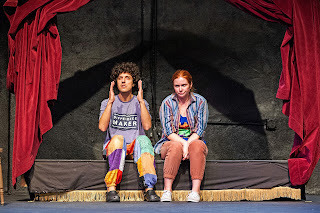
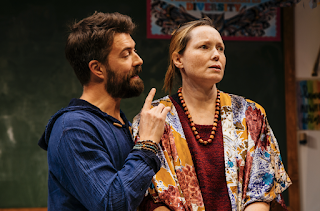
One of the men in the play is a history professor (Caden) who has always wanted to work in theater with “real” actors, though he is not sure in what role. He joins the group having already written a script with no idea that the concept of the teacher/director (Logan) is that they would come together with the Native American to develop it from scratch. Every once in a while, he inserts uncomfortable facts about the “settling” of the United States. The teacher keeps worrying, will she lose her grant; is this concept too difficult or not appropriate for the kids; how will the school board react, --- all issues that every teacher must now worry about. This dilemma is exemplified by one of the characters who says, “We don’t need actual Native Americans to tell a Native American Story. I mean, none of us are actually Pilgrims, are we?” Here are frustrated Logan and Jaxton in a similar scene in Santa Fe and at the Geffen Playhouse.


Larissa FastHorse requested that each theater where the play was produced do something that connected to their local Native community. In the case of Santa Fe, at the end the four actors come to the front of the stage, stretch out a sheet for projected images that relate to the Tewa, tribes with pueblos along the Rio Grande. who share a common language.

A theater professor at the University of Massachusetts, Amherst has said, “The importance and value of this play is theater being this mirror to hold up to society.” Isn’t that what good theater should always do and as a result make us think? In this case it also makes us laugh.

Sunday, October 31, 2021

State of the Union?

Simple question, What Union? Does it still exist? I do like to stick with the arts but from time to time I need to comment. In fact, since I am lucky enough to have a platform from which to express my views, I feel it my responsibility to do so.

We watched the hour and a half documentary on HBO called “Four Hours at the Capitol”, really an incredible piece of reporting. I would highly recommend seeing this program when it streams. Even if you feel you know what happened on that dreadful day, which will go down in infamy, but most especially if you believe the fiction that January 6, 2021 was a normal day at the Capitol.

The program was based on records of photographers and videographers present on January 6, private individuals and reporters, including at least one from the New York Times. The quality of the images and sound was far better than the rough clips we have seen on the news and they were edited into a coherent sequence.

The documentary starts with the crowd from the main trump rally on the lawn in front of the Capitol where we see the “Proud Boys” and other groups of that ilk. There is even one participant in a wheelchair commenting on the process as the group turns into a mob and they march toward the Capitol. Each time they move forward there are Capitol Police trying to hold barricades up until the rioters are hitting Police over the head with the barricades. Once inside you see a few individuals not sure where they are going before the violent crowd assaults the Capitol tunnel.


Watching the former president start to rally his followers claiming the election had been stolen from him, I wondered how I would react if a president that I had respected said that. I believe I would begin to question and delve into the issue to find the evidence. I would certainly want to know how it was possible for my party to win so many seats in the House and Senate on the same ballots as the my President lost. I think I would figure my President was in error and those around her/him had fed the President a pack of lies.

One thing I am sure of is that no matter what I believed I would not storm the Capitol in order to harm those who were in there. Even if I were somehow dragged into the Capitol, I would be careful of its architecture and its historic art commissioned for the Capitol and works left behind by former presidents. The headline of an Artnet article by Sarah Çascone read, “The Curators of the US Capitol Art Collection Say They Need $25,000 to Fix Paintings and Statues Damaged in the January Attack”.


We recently learned that even after every claim of election fraud was defeated in the courts, and state officials refused pressure to decertify ballots, a small task force at the Willard Hotel near the White House, developed plans of how to overturn the results and keep the former president in power.

As I was writing this, I went out to pick up my lunch and as I was walking down a main street here in Santa Fe, which is fundamentally a liberal town, a pickup truck drove by with a large banner flying from the truck bed that read “F…k Biden”. Is that what this country is coming to? If not insurrection, then anarchy (a state of disorder due to absence or nonrecognition of authority)? Or autocracy like the competing world powers of Russia and China?

Even if you don’t agree with my politics, I think you will agree that If no one can tell the truth anymore and be believed, the result will be the collapse of our democratic government. The HBO program “Four Hours at the Capitol” presents the evidence of how close we came on January 6.

The House Chamber in the Capitol 1-6-2021

Sunday, October 24, 2021

Does the Ethnicity of the Artist or the Sitter Matter?

I have earth shattering news today … the world has changed! The last place you usually find that happening is in our art museums.

I learned a new term reading my art blogs … at least it was new to me. That is BIPOC, i.e., artists who identify as Black, Indigenous, and/or People of Color … The topic of this particular article in Artnet News was that museums are becoming more “woke” and listening to the public outcry to acquire art by BIPOC artists and portraits of BIPOC subjects.

Don’t know about you but to think that way never dawned on me … Should it have? When I go to a museum and like a painting, I will look at the label to learn the name of the artist and never think what race they are. I sometimes think of it in 20th and 21st century art because of the subject matter or style so I become convinced that the artist must be a Black or Hispanic, but when I look up that individual, I am often wrong.

I totally understand that every group wishes to be recognized but at the same time don’t they want to be recognized as great artists and not great (fill in your ethnicity) artists? From a personal point of view, I would feel if I were referred to as a great Jewish artist, I would think does that mean I am a great artist considering that I am a Jew?

In the article I was reading Brian Boucher, a well know writer on the arts, praised the Metropolitan Museum for its bold, trail-blazing purchase of Diego Velazquez’ (1599-1660)painting of person less exalted than the subjects of his royal commissions- Juan de Pareja, an enslaved artist’s assistant of mixed blood.


I didn’t remember reading anything of the sort at the time, so I looked up what the New York Times had to say. John Canaday, chief art critic for the Times wrote about the acquisition, May 13, 1971. Why?... because of the price, $5,500,000, then a record for any work at auction. He also mentioned the deal the Museum made with the art dealers, Wildenstein to acquire the picture for them. The Met defended the expenditure in a news conference where the President of the Board, Douglas Dillon, and the Director, Thomas Hoving, assured the public that the funds had been given years before specifically for acquiring works of art. Canaday also mentioned the conservation and cleaning of the painting by Hubert von Sonnenberg, that had revealed the unexpected subtlety of the colors and also that the edge of the canvas had been folded under so the painting was even larger than had been thought. In the article the work was identified as “Velazquez’s portrait of his Moorish assistant, Juan de Pareja” without another word about the subject’s race. Here is a photo of the period showing Hoving, Dillon and Juan!


Of course, our museums should acquire works by Black, Hispanics, Asian, Native American and every other ethnicity you can think of within the framework of the institution’s collecting mission, but they should not do it just for the sake of doing so but rather because the work is of great quality by an artist that they believe in and that their audience will/should appreciate.

Sunday, October 17, 2021

A New Museum in a Town of Many

I read quite a number of art blogs and informational sites. Some of the stories I see intrigue me enough to look further. One I read recently about George Lucas (1944-) qualifies.

George Lucas is probably best known for creating the Star Wars and Indiana Jones franchises. He also formed the company Lucasfilm and spinoffs from that. He owned 100% of the former which he sold in 2012 to the Walt Disney Company transferring his $4 billion proceeds to a private philanthropy that will focus on education issues in the United States. Never fear for his remaining fortune, Forbes Magazine estimated his net worth at $7 Billion.

Now Lucas and his wife, Mellody Hobson, Co-CEO & President at Ariel Investments, areready to branch out into another world, that of museums.

They are in the process of building and opening “The Lucas Museum of Narrative Art”. Narrative Art? That is what I dealt in my entire life, European art of the 14th through the 19thcenturies was always narrative, starting with the religious, the mythical and historical events, all narrative art. But Lucas can add other dimensions photography, the first photograph circa 1826 and more importantly the moving picture, 1895, being a huge jump in the development of narrative art.

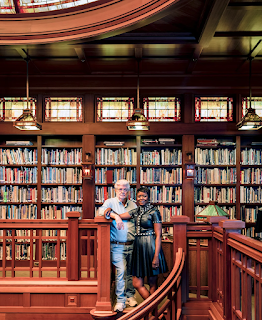
George Lucas & Mellody Hobson

By my count there are 8 art museums in Los Angeles including the Los Angeles County Museum, The Huntington and The Getty. Earlier attempts by Lucas and his wife to build their museum in San Francisco and then Chicago were thwarted by politics and neighborhood objections. L.A. seemed to be most hospitable to the idea. Also, influenced by Hobson, Lucas was attracted to the idea of having his new institution being used as a teaching tool for young people and there are plenty of schools and universities in L.A. to draw from.

The flowing futuristic museum building by architect Ma Yansong will feature new public green space, cinematic theaters, a research library, and space for onsite education. It was supposed to be completed this year but due to Covid issues will only be finished later next year and plans to open in 2023.

Rendering of the Lucas Museum

Just building a collection can be complicated but multiply that by a thousand if you wish to establish a museum. In 2014 Lucas wisely hired an advisor, Don Bacigalupi who was a curator specializing in contemporary art and popular culture and Director at several museums including Toledo Museum of Art before joining The Crystal Bridges Museum which he helped Alice Walton develop.

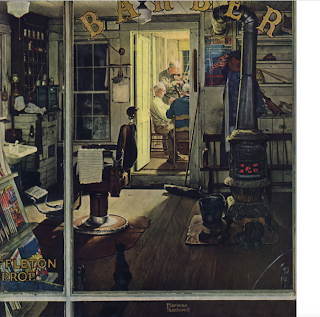
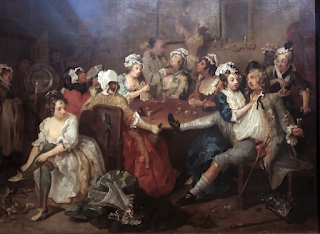
You might have thought that the Lucas Museum would deal with just film and photography. What is not well known is that Lucas also has a serious art collection by artists such as Norman Rockwell, Thomas Hart Benton, Jacob Lawrence, Romare Bearden, Maxfield Parrish, Kerry James Marshall and Frida Kahlo. While the bulk of the collection includes 20thand 21st century art, there are old masters as well. Here are three examples of Narrative Art from the collection: (3 Images, Captions Below)

Norman Rockwell (American 1894-1978)
“Shuffleton's Barbershop”, 1950

William Hogarth (British 1697-1764)
from his series “The Rake’s Progress”, 1732-34

Artemisia Gentileschi (Italian 1593-1653) and associate,
The Triumph of Galatea, about 1649

His new museum with its 80,000 square feet of exhibition space will include paintings, sculpture, photography, movies, illustration, comic art and “Star Wars” ephemera. When Lucas said, “Why I have 15,000 works of art is because I can’t let go of them” he was being modest because including the other material, his collection now numbers around 100,000 works.

“The focus of the Museum is to open up people's imaginations and inspire them to dream beyond what is considered possible,” Lucas explains, “Narrative art and storytelling stirs our emotions, shapes our aspirations as a society, and is the glue that binds us together around our common beliefs.” Appointed in 2020 as Director and CEO of the Museum, Sandra Jackson-Dumont comes from the Metropolitan Museum of Art where she was Chairman of Education and Public Programs Department. She faces the challenge of realizing a museum with the Lucas concept,-- to dream beyond what is considered possible.